You Don't Know If Your Chatbots Are Working
- Published:
- Updated:
- Authored by
-
 Sean Minter Founder, CEO
AI agents and chatbots are handling more of your customer service than ever, but you still don't know if they're working.
Self-service has expanded across the customer journey as companies route more service interactions through chatbots, virtual agents, IVR, and other automated channels with 53% of the 497 customer-contact leaders surveyed by CMP Research ranking chatbots and virtual agents as their top technology investment for 2026-2027. Contact centers have more automation in front of the customer, but automation records stay separate from what happened to the customer post-session. Without visibility across those records, all you have is what the automation reported about itself.
Agentic AI deployment has outpaced the quality assurance and customer experience tracking required to know its impact on the customer journey.
The problem isn't that chatbots don't work, it's that you don't know if they're working.
Chatbots can report a successful resolution while the customer is still trying to resolve their issue somewhere else, but without connected tracking from first contact through the handoff, how do you know?
Ask your reports whether "resolved" stayed resolved, if the customer called back, or whether the handoff transferred the customer's context, you'll find one answer comes back, you don't know.
AI Agents Handle Interactions Your QA Team Can't See
Even though more of the customer journey is beginning with AI agents, your customers' needs still haven't changed, "did my issue get resolved?"
AI agents, chatbots, and virtual agents handle password resets, order status, billing questions, appointment changes, and return requests before a human agent sees them, but as automated channels take on more challenging customer interactions, the blind spots get more expensive.
Manually reviewing AI agent interactions and comparing them to customer resolution reporting holds up at a few thousand automated interactions a month, depending on team size, while routing tens of thousands of chats, virtual agent conversations, and IVR journeys through automation leaves you relying on what chatbot containment and completion metrics report about customer interactions your CX and QA teams can't see.
Containment and Completion Don't Prove Customer Resolution
Containment tells you whether the customer stayed in self-service, while completion tells you whether the chatbot or virtual agent reached the intended end of its workflow, but neither containment nor completion tracks the customer's issue after the interaction ends.
Customer resolution has a stricter standard, including correct answers, requested actions taking effect, promised next steps happening, and an issue staying "resolved" after the chatbot closes the interaction.
Once you route customers to AI agents, resolution tracking breaks at the handoff, disconnected from a customer journey starting with an AI agent and ending with a live agent. Containment and completion only prove the bot reached an end state, so how do you score the quality of the interaction, judge how the bot handled the customer, or place fault when the issue went unresolved with both agents?
Gartner found that 73% of customers use self-service at some point, with 14% of customer-service and support issues fully resolved through self-service, rising to 36% when customers describe the issue as very simple. Gartner's 73% figure measures customer use, while the 14% and 36% figures measure issue resolution. Neither figure tells you what happened to the issue after the session closed, so how do you find out?
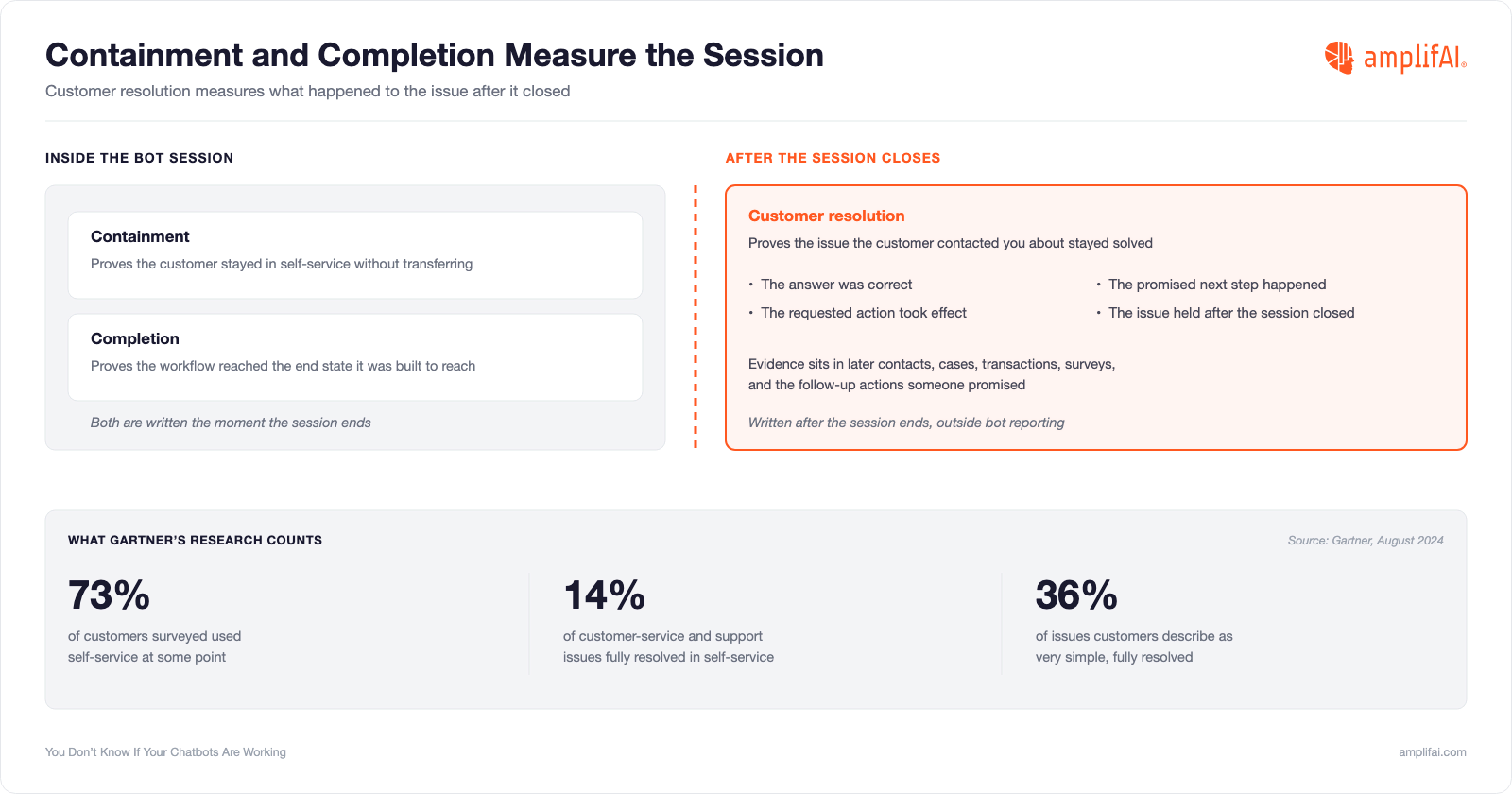
Investment budgets favor containment, as containment rates look better on paper. Contact centers set containment targets, report success rates upward, and fund more self-service automation with containment rising, while a chat abandoned by the customer without asking for a human still counts as successful. A 50% escalation rate on password resets is a defect, 90% on billing disputes may be policy-driven routing to live agents, while an aggregate escalation rate doesn't tell you which you have. Automation roadmaps, staffing plans, and executive reporting rest on measurements unable to separate a solved issue from an abandoned one.
AI Agent Quality Monitoring Is Disconnected from the Customer Journey
Your AI agent reporting dashboards hold the intent recognized, path taken, tasks completed, and transfers started. Reporting depth isn't the limit on AI agent quality, reach is.
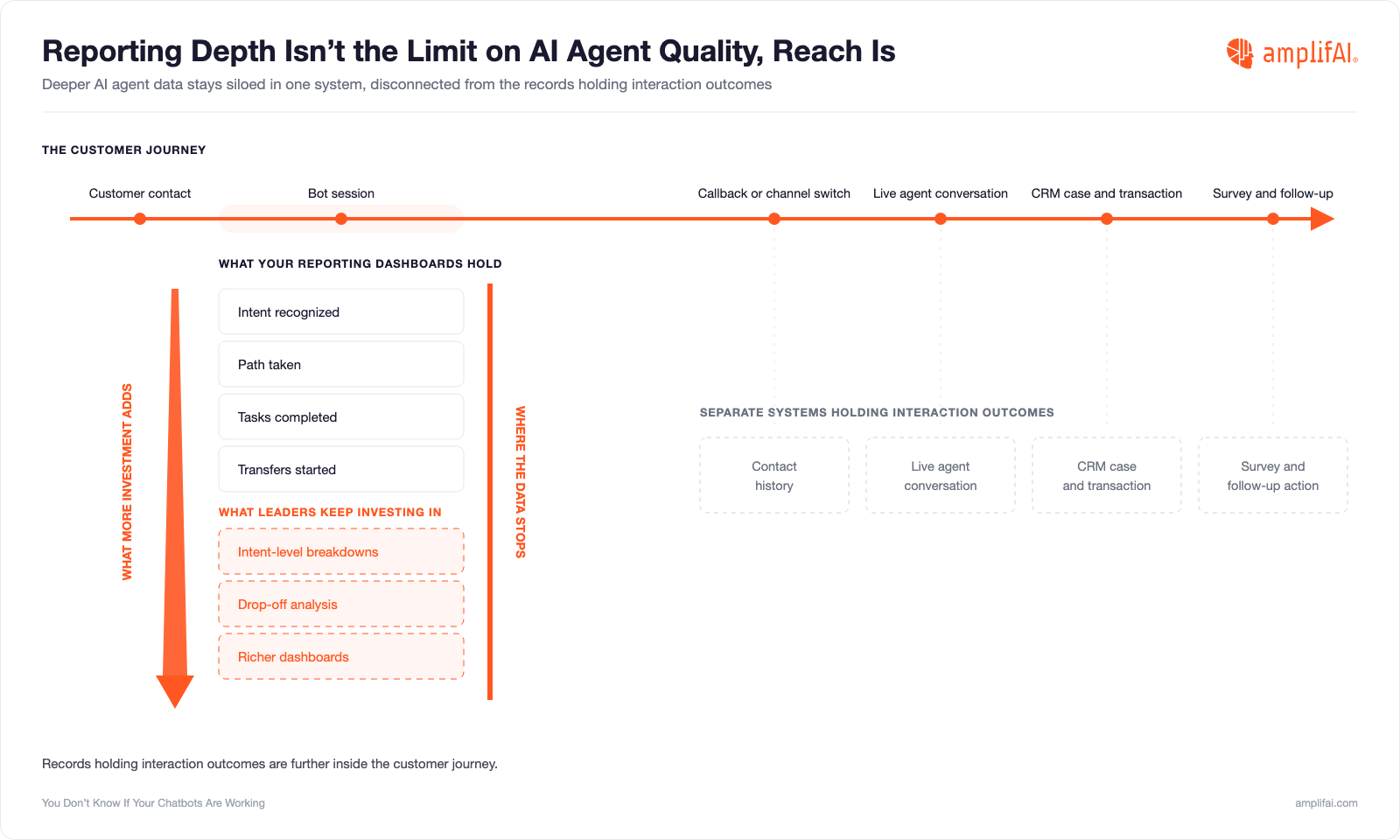
CMP Research found 49% of executives naming automated QA and quality management a top technology investment priority for the next two years, and buyers asking for software grading AI voicebots and chatbots alongside live agents. What AI agent reporting currently offers instead is depth, with richer dashboards, intent-level breakdowns, and drop-off analysis, while scoring the automated session apart from the human conversation following it.
Failed Self-Service Drives Repeat Calls and Channel Switching
Failed self-service displaces customer support demand instead of resolving it. Chatbots close the interaction (whether resolved or not, you don't know), the customer ends up calling back, starting another chat, switching channels, or reopening a case to resolve their issue. When customer resolution reporting treats contacts as separate interactions, a contained bot session and its callback appear unrelated even though the customer is still trying to resolve one issue.
We spoke with 13 companies, all raising an important question about containment and deflection, "why do customers who went through self-service still end up with a live agent?" Containment and deflection reports stop at the session, so you don't know whether the cause was intent the bot misread, an answer missing from the knowledge base, a task completed while the action behind it never executed, escalation logic firing too late, a scripted path the customer's situation didn't fit, or an authentication step the bot couldn't finish. Any one of those causes tells you something different to fix, but your reporting captures none between the self-service session and the handoff.
68% of customers won't use a bad chatbot again, so your contact center absorbs repeated callbacks, your customers spend extra effort to resolve their issues, and your live teams carry what self-service didn't resolve. Chatbots look like the hero while unfixed failures repeat.
AI-to-Human Transfers Leave the Handoff Unmeasured
AI-to-human transfers change who's handling the customer's issue, but they don't change the contact reason. Escalation decision, transferred context, human conversation, and final outcome are all part of the customer journey. When context doesn't follow the customer, your live teams inherit inadequate conversation history and progress toward resolution, forcing the customer to repeat information and the agent to reconstruct the issue.
We spoke with a global health and wearable technology brand fielding about 24,000 chatbot conversations a month alongside 22,000 handled by human agents. QA teams scored the human conversations against a quality framework and left the chatbot conversations unscored. More than half of the company's customer service interactions lacked a quality standard. When a transfer crossed between chatbot and agent, QA teams scored the human agent on a conversation begun inside an unscored chatbot session, with no way to tell whether a low score belonged to the agent or the chatbot.
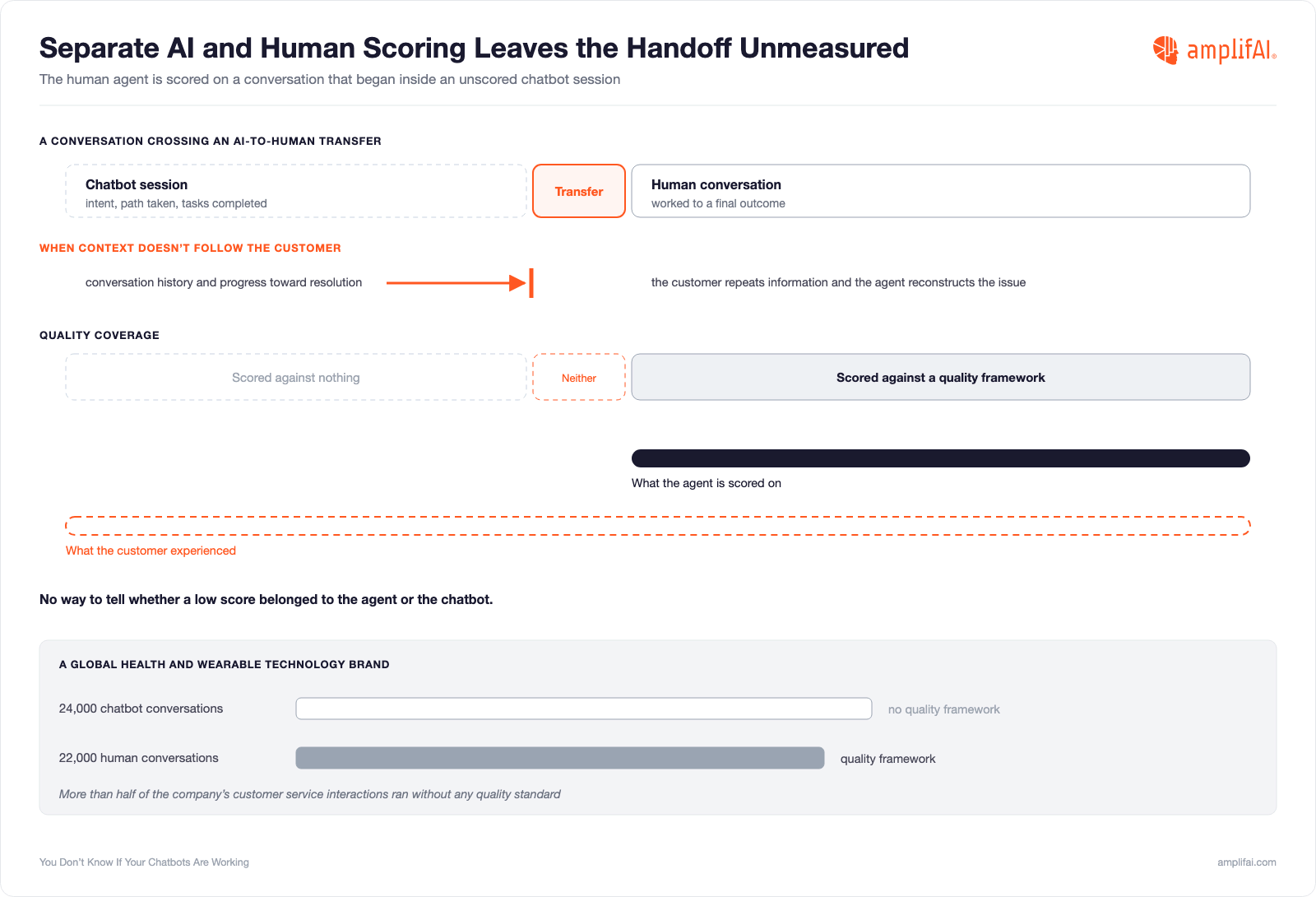
Disconnected AI and human scoring evaluates the chatbot's escalation and the agent's conversation independently, leaving the handoff itself unmeasured. You need to connect the AI interaction to the human conversation and customer outcome to know if AI agent escalation preserved the journey or shifted more effort onto the customer. 74% of consumers find it frustrating to repeat their story to different agents.
Customer Journey Measurement Breaks Without Unified Interaction and Business Data
Your AI agents produce transcripts, intent tags, confidence scores, path history, and session metadata, combining to describe what happened inside self-service customer interactions. What happened to the customer afterward sits in other records, including contact history (showing whether they came back), live agent conversation history, CRM cases, transactions (whether they posted or failed), survey responses, and follow-up actions promised.
Joining those records without unifying them is where customer journey measurement breaks. Your chatbots log a session ID, your CRM opens a case number, telephony writes a call record, and your survey returns a response ID, without a shared key naming the customer in all four. Your contact center holds all the evidence needed to prove whether your chatbots are working, but doesn't have a way to assemble it into one cohesive journey.
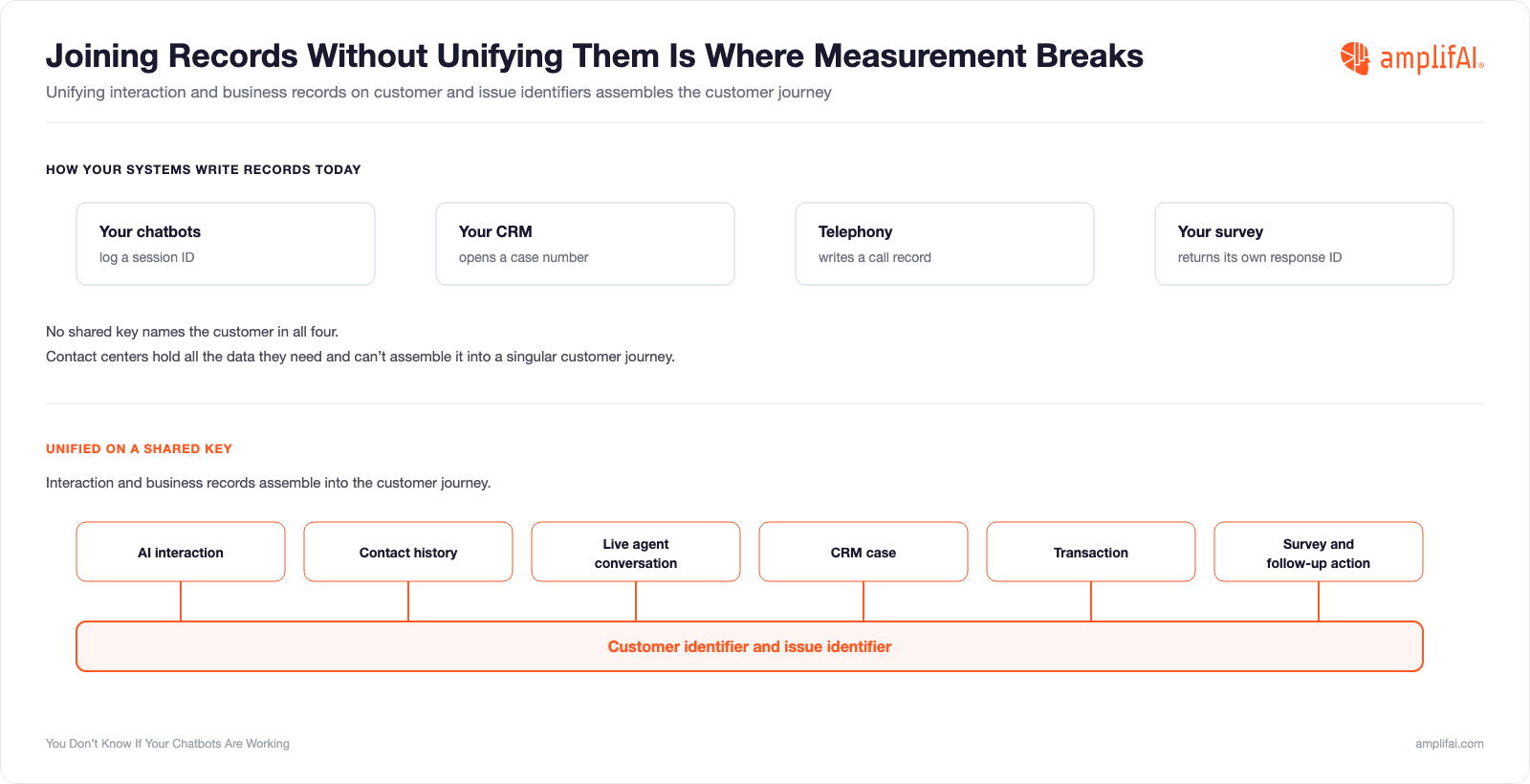
Eight companies asked us "how do we get the bot's data out?", naming bot metadata with no export path, chatbot and IVR data resisting ingestion, customer IDs differing between systems, and transcripts arriving without the human side of the conversation attached as primary pain points. All four pain points share one need, the ability to unify AI agent interaction data from first contact through the handoff with live team conversations, scoring them against a shared outcome standard, connected to the entire contact center record.
Without joining a bot session to what followed, you can't tell which automated intents resolve a customer's issue and which ones displace it. What happened and how well the AI agent performed are different questions.
AI Agents and Live Teams Need Separate Scoring Criteria
To your customer, a successful interaction looks like their issue resolved quickly and accurately, whether a human or an AI agent handled it. Gartner holds AI-driven service to the quality, customer experience, and outcome standards human agents achieve, but how do you measure quality when human agents show quality through behavior and judgment observable in the conversation, while AI agents show it through decisions, grounding, and system behavior recorded in the interaction?
| Customer Outcome | Human Conversation Evidence | AI Interaction Evidence |
|---|---|---|
| Customer Issue Understood | Discovery and confirmation of the request | Intent accuracy and request confirmation |
| Frustration Caught Early | Empathy and de-escalation in the conversation | Frustration detection and escalation trigger |
| Accurate Escalation and Resolution Path | Escalation judgment | Containment decision accuracy, escalation timing, context transfer |
| Complete Issue Resolution | Resolution ownership and follow-through | Resolution completeness, factual accuracy, executed actions, customer confirmation |
| Minimal Customer Effort | Effort management through the conversation | Repetition, dead ends, and friction in the automated path |
| Information Accuracy and Compliance | Policy adherence | Knowledge grounding, hallucination rate, disclosure compliance |
| Context Carried Forward | Disposition and wrap-up accuracy | Contact reason tagging and outcome logging accuracy |
| Issue Stays Resolved | Commitments made and closed after the call | Reopen rate and no follow-up contact in seven days |
Customers bring a different expectation to a bot than they bring to a live agent. A customer interacting with a self-service bot or an AI agent wants the answer and wants it now, without the rapport-building, small talk, or conversational warm-up standing between the question and the resolution. Customers expect empathy, friendliness, and conversational skill from human interactions. Frontline agents create the customer experience by demonstrating all three, but grading AI automation on them is the wrong call.
Contact centers building AI evaluations from agent scorecards train bots toward conversation when your customer came for speed, adding turns to an interaction your customer chose to save time. Grading AI agents on warmth lowers the customer experience you deployed automation to improve, while hallucinated answers, dropped context on transfer, and confident responses built on thin knowledge are unscored. Many contact centers built their AI scorecard from the agent scorecard.
Five enterprises asked us two questions in our most recent discussions, "who grades the bot?" and "how does bot quality compare to human quality on the same customer need?" You don't know without connected systems unifying your interaction and business data, managing your agentic, human, and hybrid workforces, and tracking performance and CX outcomes across the entire customer journey.
How You Know Your Chatbots Are Working
You know your chatbots are working when your customer's issue is resolved, stays resolved, and is scored as one customer journey from first contact through handoff.
Gartner research on evaluating AI-driven customer interactions tells service leaders to hold automation to validated customer outcomes. Gartner set the bar with AmplifAI AI agent management software, showing what one customer interaction should look like when monitored, managed, and connected end to end, including the AI segment, handoff, and human conversation scored with customer outcome attached to all three.
AmplifAI's AI-powered platform for CX and performance management unifies your interaction and business data from 150+ sources across CCaaS, CRM, WFM, and homegrown systems, joining bot sessions to live agent conversations, cases, transactions, and survey responses. AmplifAI manages performance across the entire customer journey, scoring AI agents and live teams on separate evaluation forms under one standard, turning a low score into a corrective action, such as coaching for your live teams or diagnosis and redeployment for your AI agents, and measuring whether your customer outcomes improved.
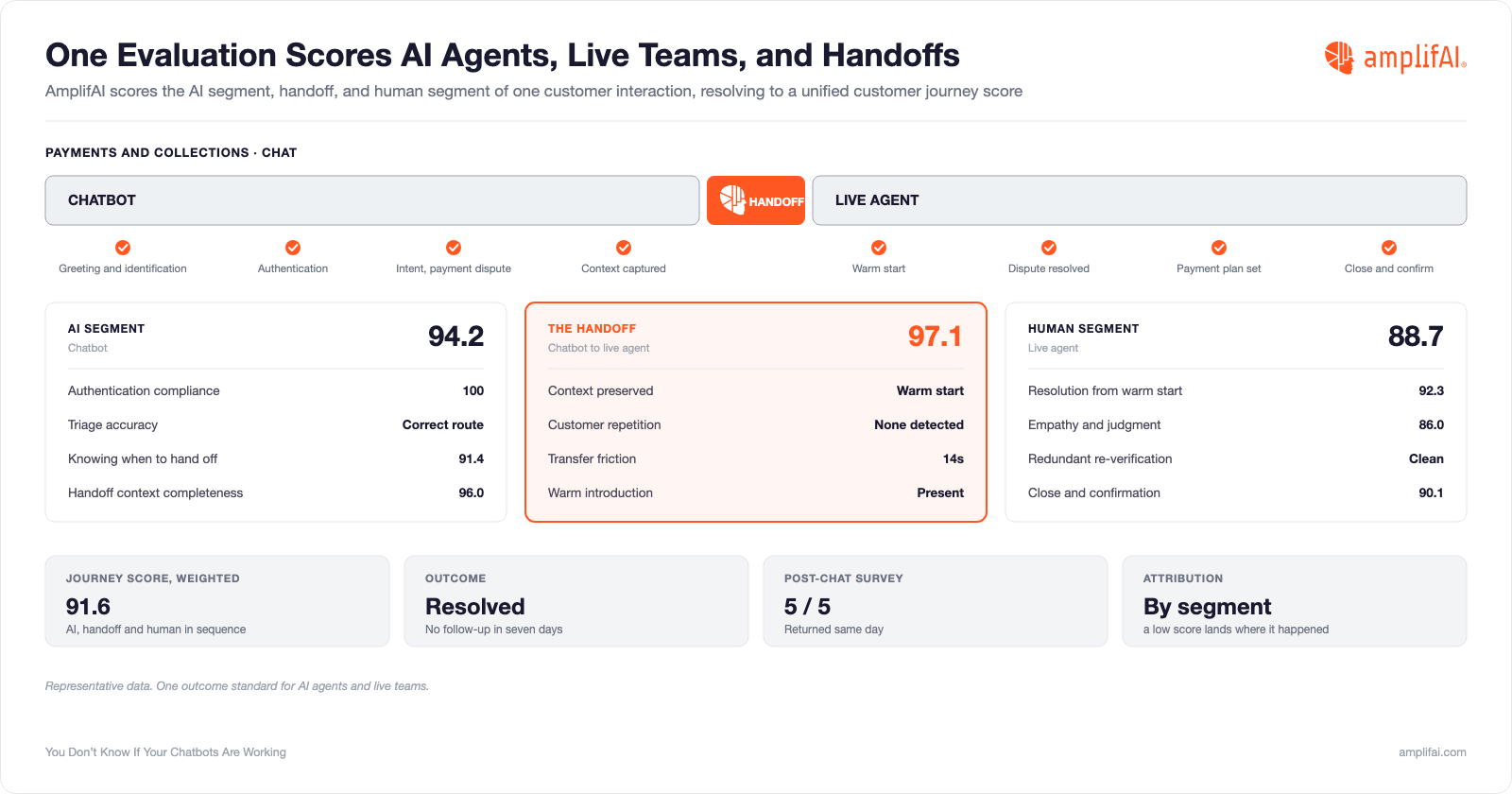
As AI agents take on more of the customer journey, with models improving and costs dropping, you see less of your customer experience, unless measurement scales with automation.
Your AI agents report on themselves, so you need to hold them to what happens after customer interactions end, through a unified approach to AI agent management.
To see what a customer journey scored end to end across AI agents and live teams looks like, speak to a CX leader at AmplifAI.