AI Coaching in Call Centers: AI-Led vs AI-Enabled Coaching
- Updated:
- Authored by
-
 Richard James Director of Organic Growth and CX
AI coaching in call centers promises to improve agent performance at scale, yet most solutions grouped under the AI coaching label solve entirely different problems, the distinction between the different AI coaching types determines whether performance improves.
AI-led coaching delivers real-time prompts to agents during live interactions, guiding responses in the moment while bypassing the team leader, whereas AI-enabled coaching strengthens the coaching process by surfacing performance data, identifying patterns, and equipping team leaders with the insights needed to develop agents over time. AI-led and AI-enabled coaching operate in different parts of the contact center and produce different outcomes.
Bachkirova and Kemp’s research on AI in coaching highlights the gap between real-time AI prompting and coaching that drives sustained behavioral change, showing that autonomous AI interactions lack the relational and contextual depth required for effective coaching, particularly in complex scenarios where behavioral change depends on human judgment and continuity. Real-time assistance can support an agent through a difficult moment, but sustained performance improvement requires coaching that compounds across interactions.
Effective AI coaching needs to support how the agent coaching process actually works, with data informing human decision-making, coaching sessions connecting to measurable outcomes, and performance improvement building over time.
Distinguish between AI-enabled coaching and AI-led prompting to choose the right approach for your use case.
Looking for call center coaching software built on AI? Read the 13 Best AI-Powered Call Center Coaching Software (2026) guide, which grades vendors on their AI capabilities, including the data it coaches from, decisions it makes, actions it takes, and how well it measures improvement in agents and coaches alike.
What is AI Coaching?
AI coaching is the use of generative AI to support coaching in a call center, either by interacting directly with agents or by equipping human coaches with the data, insights, and recommendations needed to coach more effectively.
AI coaching separates into two distinct models within a contact center, AI-led coaching and AI-enabled coaching, where AI-led coaching interacts directly with agents and AI-enabled coaching supports the coach driving performance improvement.
Types of AI Coaching in Call Centers
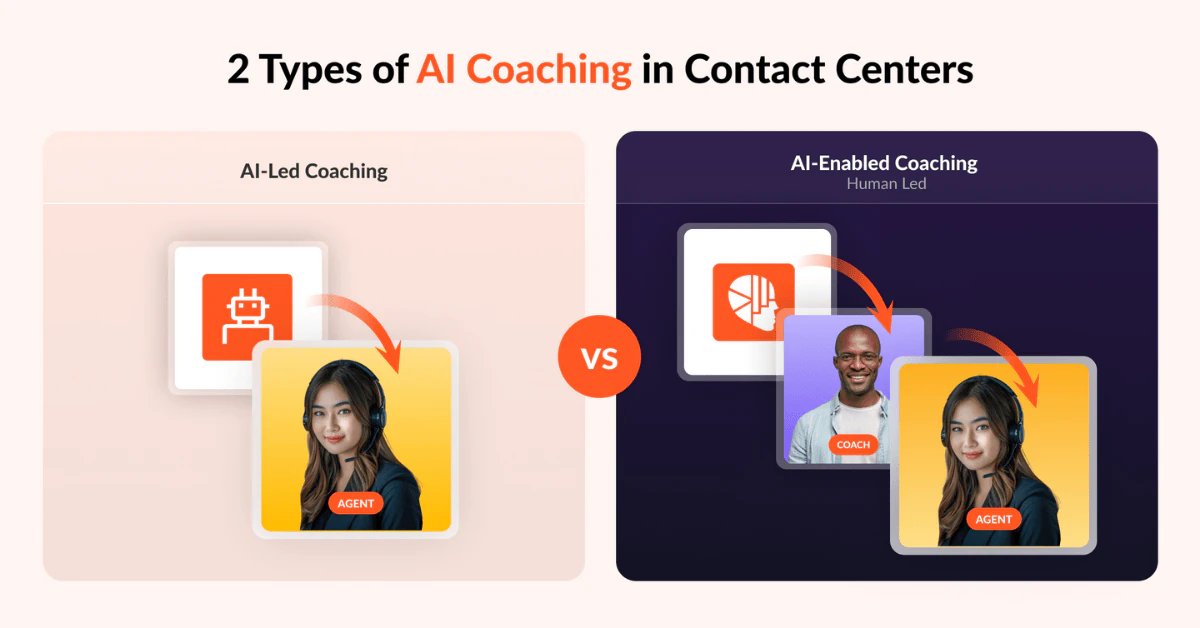
AI coaching in a call center breaks into two types, AI-enabled and AI-led, each solving different problems across the contact center.
| Capability Layer | AI-Led Coaching | AI-Enabled Coaching |
|---|---|---|
| Primary function | Delivers real-time prompts and guidance to agents during live interactions | Strengthens the coaching process through data, insights, and next best actions |
| Who does the coaching | AI interacts directly with agents without a human coach | Human coaches lead, supported by AI-driven insights |
| Operational moment | During the call | Before and after the call |
| Data inputs | Live interaction context and conversation data | Cross-system data including QA, performance metrics, CRM, and interaction history |
| Data usage | Interaction-level prompting based on live conversation context | Cross-system analysis of QA, performance, and behavioral trends |
| Performance impact | Assists agents during live interactions | Drives measurable agent performance improvement over time |
| AI-Led Coaching supports in-call agent assistance through real-time prompting, while AI-Enabled Coaching improves performance through data-driven coaching workflows and sustained development. | ||
1. AI-Led Coaching
AI-led coaching interacts directly with agents, delivering prompts, guidance, and feedback during or immediately after a customer interaction without a human coach in the loop. AI-led coaching is also referred to as real-time agent assist, functioning as an in-the-moment assistant that helps agents navigate live calls.
AI-Led Coaching Features:
- Real-time assistance during customer interactions
- Automated performance analysis at the interaction level
- Immediate feedback delivered to the agent
- Always-on availability across shifts
How AI-Led Coaching works:
- Natural language processing analyzes the agent-customer interaction as it happens
- Machine learning identifies moments where the agent needs support
- The system delivers prompts and suggestions to the agent during the call or in the wrap-up window
AI-led coaching drives the widespread use of “AI coaching” as a catch-all term in the call center software market, where any system surfacing guidance to an agent becomes categorized as coaching, despite solving a fundamentally different problem than coaching that improves performance over time.
2. AI-Enabled Coaching
AI-enabled coaching supports the human coach rather than replacing them, keeping coaching person-to-person between a team leader, supervisor, or quality trainer and the agent, while AI handles data analysis, pattern detection, and the pre-session and post-session work that consumes the coach’s time.
AI-enabled coaching equips team leaders, supervisors, managers, quality trainers, and executives with the data, insights, and recommended actions needed to deliver effective coaching at scale, while preserving the human relationship required for behavioral change.
AI-Enabled Coaching Features:
- Aggregation and analysis of call recordings, chat transcripts, QA scores, and CRM data
- AI-generated performance insights and coaching recommendations
- Predictive analytics surfacing coaching opportunities before performance slips
- Integration with existing coaching workflows and cadences
How AI-Enabled Coaching Works:
- Call recordings, chat logs, QA evaluations, and CRM data flow into a unified analysis layer
- AI identifies performance trends, real-time KPI movement, and specific coaching opportunities for each agent
- The system generates next best actions and session-ready recommendations for the human coach, along with coaching effectiveness measurement after the session
AI-enabled coaching aligns with outcomes tied to sustained agent performance improvement, reduced attrition, and coaching that compounds over time through a human relationship between coach and agent.
AI Coaching Use Cases in Call Centers
AI coaching use cases in call centers fall into two operational moments, the live call and the coaching practice surrounding it. Each use case ties to measurable outcomes across AHT, FCR, CSAT, attrition, and compliance, where aligning the use case to the appropriate AI coaching model determines whether performance improves.
| AI Coaching Use Case | Description | AI-Led Coaching | AI-Enabled Coaching |
|---|---|---|---|
| Automate coaching prep | AI gathers recordings, QA scores, and performance patterns into session-ready insights, evidence, and next best actions for the team leader. | ❌ | ✅ |
| Unify performance data | AI aggregates recordings, transcripts, QA evaluations, CSAT, schedule adherence, and CRM activity into one coachable view. | ❌ | ✅ |
| Standardize coaching | AI delivers the same data, focus areas, and coaching actions to all team leaders, removing variance from coaching practice. | ❌ | ✅ |
| Personalize coaching plans | AI analyzes each agent's performance patterns, behaviors, and history, then generates coaching recommendations specific to that agent. | ❌ | ✅ |
| Coach effectiveness measurement | AI tracks the connection between specific coaching actions and subsequent KPI movement, replacing activity metrics with outcome metrics. | ❌ | ✅ |
| Replicate top performers | AI analyzes high performer interactions and extracts the specific behaviors, talk tracks, and decision patterns that correlate with strong outcomes. | ❌ | ✅ |
| Real-time agent guidance | AI listens to the live conversation and delivers prompts, answers, and script reminders to the agent during the call. | ✅ | ❌ |
| New agent onboarding | AI guides new agents through unfamiliar call flows, system navigation, and product knowledge on live calls, shortening ramp time. | ✅ | ❌ |
| Compliance script adherence | AI prompts the agent in the moment when a required disclosure is missing or a regulated phrase needs to be delivered. | ✅ | ❌ |
| Knowledge base | AI surfaces relevant answers from knowledge bases, internal wikis, and policy documents based on what the customer just asked. | ✅ | ❌ |
| AI-Enabled Coaching supports coaching practice use cases through data, insights, and effectiveness measurement, while AI-Led Coaching supports in-call agent use cases through real-time prompting. | |||
1. Automate Coaching Prep
Coaching prep is the highest cost on a team leader’s week, with pulling call recordings, reviewing QA scores, identifying performance patterns, and building session agendas consuming 30 to 45 minutes per agent. AI-enabled coaching handles the prep work, delivering session-ready insights, evidence, and next best actions to each team leader before the session starts. AI-led coaching operates during live calls and does not support the coaching workflow before and after the interaction.
2. Unify Performance Data
Call centers generate more data than any team leader can manually process, with call recordings, chat transcripts, QA evaluations, CSAT surveys, schedule adherence reports, and CRM activity fragmented across systems. AI-enabled coaching aggregates this data into a single coachable view, identifying behaviors, scores, and trends that warrant a coaching conversation. AI-led coaching operates on live conversations and does not unify performance data across systems.
3. Standarize Coaching
Coaching quality varies based on team leader experience, style, and personal bias, reflected in performance differences between teams under different supervisors. AI-enabled coaching standardizes coaching inputs across team leaders, including data, recommended focus areas, and coaching actions, so agent performance reflects coaching quality consistently. AI-led coaching standardizes agent-facing prompts in the moment, delivering the same response to the same trigger across agents rather than standardizing the coaching practice across coaches.
4. Personalized Coaching Plans
Effective coaching is specific to each agent, but scaling that level of personalization across a 200-agent or 2,000-agent roster manually is impossible. AI-enabled coaching analyzes each agent’s performance patterns, behaviors, and history, then generates coaching recommendations for human coaches to deliver. AI-led coaching personalizes prompts in the moment based on live calls, supporting in-call interactions rather than the sustained development that happens between coach and agent over time.
5. Coach Effectiveness Measurement
Call centers measure coaching activity, including sessions held, time spent, and topics covered, but few measure whether coaching improves agent performance. Coaching can't be optimized without measuring effectiveness. AI-enabled coaching closes that gap, tracking how specific coaching actions connect to subsequent KPI movement. AI-led coaching prompts agents during calls without measuring coaching impact over time.
6. Replicate Top Performers
Call centers have top performers whose behaviors, talk tracks, and decision patterns drive measurably better outcomes, but those behaviors stay locked with the individual because teams lack a way to identify and replicate them. AI-enabled coaching analyzes top performer interactions and extracts the behaviors that correlate with strong outcomes, turning them into coaching actions team leaders apply across the team. AI-led coaching works at the interaction level and does not replicate performance patterns over time.
7. Real-Time Agent Guidance
Traditional coaching happens after calls end, with agents receiving feedback days or weeks later. AI-led coaching supports agents during live interactions, delivering prompts for compliance, knowledge, and sales guidance in the moment. AI-enabled coaching strengthens the coaching process before and after each interaction, using performance data and behavioral patterns to drive sustained agent development.
8. New Agent Onboarding
New agents face a steep learning curve across call flow, system navigation, and product knowledge, impacting average handle time, first call resolution, and customer experience during ramp. AI-led coaching shortens ramp by guiding new agents through unfamiliar workflows on live calls, surfacing the next step in a process or the correct field in a CRM. AI-enabled coaching surfaces ramp gaps for human coaches to address through structured coaching, building the skills agents need to perform without in-call assistance over time.
9. Compliance Script Adherence
Regulated industries such as financial services, healthcare, and collections require agents to deliver specific disclosures and follow scripted language on every call. Manual compliance monitoring catches violations through QA sampling after calls end, often weeks later. AI-led coaching prompts agents in the moment when a required disclosure is missing or a regulated phrase needs to be delivered, addressing compliance at the point of risk. AI-enabled coaching flags adherence gaps during QA evaluation after calls end and tracks compliance trends over time.
10. Knowledge Base
Agents lose handle time searching knowledge bases, internal wikis, and policy documents during live interactions. AI-led coaching surfaces relevant answers based on the customer’s request, removing the lookup step from the call. AI-enabled coaching analyzes knowledge base usage patterns over time to identify gaps in agent training and content, informing coaching and content updates without delivering answers during the interaction.
Limits of AI-Led Coaching
AI-led coaching can’t build a coaching relationship, delivering prompts during interactions while in contrast agent development happens through ongoing work between a team leader and the agent. Research on AI in coaching shows the gap between AI-led prompting and human coaching.
"(Human) Coaching became an intervention of choice in organizations and continues to be as such according to its essentially human elements that can be eroded in AI-Led coaching. No amount of technical sophistication could change that." "We believe that the essential features of professional organizational coaching cannot be replicated by AI-Led Coaching in principle. Even in the future, when as argued by some, it will pass the Turing test by exhibiting intelligent behaviour indistinguishable from that of a human, these criteria could not be met."
Source: AI coaching: democratizing coaching service or offering an ersatz?, Bachkirova and Kemp, 2024
Evaluating AI Coaching Software
Evaluating AI coaching software starts with the outcomes you’re trying to improve, then map those outcomes to the type of AI coaching each vendor delivers.
AI-enabled coaching improves agent performance by strengthening the coaching process, including coaching preparation, standardization across team leaders, effectiveness measurement, and the ability to replicate top performer behaviors.
AI-led coaching supports agents during live interactions, delivering prompts for compliance, knowledge, and in-call guidance.
Use the evaluation criteria below to assess how each approach connects data, coaching workflows, and performance outcomes.
| AI Coaching Software Evaluation Criteria | Why It Matters |
|---|---|
| Coaching Model (AI-Led vs AI-Enabled) | AI-led coaching delivers prompts during calls, while AI-enabled coaching strengthens the coaching process. Match the model to your goal. |
| Data Integration Across QA, CRM, and CCaaS | AI-enabled coaching depends on complete performance data. Gaps across QA, CRM, or interaction data limit the ability to identify patterns and generate accurate coaching insights. |
| Coaching Workflow Alignment | Coaching insights need to connect to prep, sessions, and follow-up, disconnected insights limit performance improvement. |
| Coaching Effectiveness Measurement | Tracking how coaching actions connect to KPI movement separates activity from impact. |
| Performance Pattern Identification | AI coaching should identify behaviors and trends across agents, enabling targeted coaching and replication of top performer performance. |
| Real-Time Agent Guidance | For in-call use cases, evaluate how AI-led coaching delivers prompts for compliance, knowledge, and workflow guidance during live interactions. |
| Scalability Across Teams | Scaling coaching needs consistent data, workflows, and visibility across teams. Variation breaks coaching quality and performance tracking. |
| Role-Based Visibility | Team leaders, QA analysts, and executives require different views of performance and coaching data to take action. |
| Integration with QA and Performance Management | Connecting QA scores, performance data, and coaching insights reflects actual performance gaps. |
| Time to Value | Faster deployment only matters when coaching insights connect to measurable performance improvement. |
| Decision Logic: Evaluating AI coaching software requires aligning the coaching model to your use cases, connecting coaching insights to complete performance data, and verifying that coaching actions link directly to measurable outcomes. In-call prompting addresses immediate needs, while coaching process improvement drives sustained performance. | |
How AmplifAI Applies AI-Enabled Coaching
AmplifAI delivers AI-enabled coaching by connecting QA, performance management, conversation intelligence, and CX data into a single coaching workflow, where coaching preparation, session execution, and performance tracking all draw from the same data foundation. AmplifAI’s Coaching Effectiveness Index measures how specific coaching actions connect to KPI movement, giving team leaders visibility into which coaching drives improvement and where performance stalls.
For a full vendor comparison across AI coaching software types, features, and use cases, see the call center coaching software guide.
Explore Related Contact Center Software Categories
AI coaching connects to multiple layers of the contact center, including QA, performance management, conversation intelligence, and AI-driven workflows. The guides below break down each category, comparing vendors and capabilities within the areas that support coaching, performance, and customer experience.
| Software Buyer's Guide | What It Covers | Top Vendors |
|---|---|---|
| Call Center Software | Complete taxonomy of call center software categories with top vendors for customer service and support | AmplifAI, NICE, Genesys, Verint, CallMiner |
| Contact Center as a Service (CCaaS) Software | Full review and comparison of the best Contact Center as a Service (CCaaS) software in 2026 | NICE CXone, Genesys Cloud CX, Five9, Zoom, Talkdesk |
| Call Center CRM Software | Full review and comparison of the best call center CRM software in 2026 | Salesforce Service Cloud, Microsoft Dynamics 365, HubSpot Service Hub, Zoho CRM, Oracle CX |
| Contact Center AI Software | Full review and comparison of the best contact center AI software in 2026 | AmplifAI, Dialpad, Five9, Genesys, NICE |
| AI Agent Management Software | Full review and comparison of the best AI agent management software for customer service in 2026 | AmplifAI, Cresta, NICE, Observe.AI, Kore.ai |
| Call Center Workforce Management Software | Full review and comparison of the best call center workforce management software in 2026 | NICE CXone, Verint, Genesys Cloud, Assembled, Five9 |
| Call Center Speech Analytics Software | Full review and comparison of the best call center speech analytics software in 2026 | AmplifAI, CallMiner, NICE, Observe.AI, Verint |
| Call Center Analytics Software | Full review and comparison of the best call center analytics software in 2026 | AmplifAI, NICE CXone, Verint, Genesys Cloud, CallMiner |
| Call Center QA Software | Full review and comparison of the best call center QA software in 2026 | AmplifAI, CallMiner, Dialpad, NICE, Observe.AI |
| Call Center Performance Management Software | Full review and comparison of the best call center performance management software in 2026 | AmplifAI, Genesys, NICE, Talkdesk, Verint |
| Call Center Coaching Software | Full review and comparison of the best call center coaching software in 2026 | AmplifAI, Centrical, Cresta, EvaluAgent, Observe.AI |
| Call Center Gamification Software | Full review and comparison of the best call center gamification software in 2026 | AmplifAI, Centrical, Cresta, Genesys, NICE |
| Customer Insights Software | Full review and comparison of the best customer insights software in 2026 | AmplifAI, CallMiner, Cresta, Observe.AI, Tethr |
AI Coaching in Call Centers FAQ's
What is the difference between AI-led and AI-enabled coaching?
AI-led coaching delivers real-time prompts to agents during live interactions, helping them respond in the moment. AI-enabled coaching supports human coaches by analyzing performance data, identifying patterns, and recommending coaching actions that improve agent performance over time.
Does AI coaching improve agent performance?
AI coaching improves agent performance when it strengthens the coaching process through data, measurement, and consistent coaching practices. Real-time prompting supports agents during calls, but sustained performance improvement depends on coaching that connects actions to measurable outcomes over time.