How to QA AI Agents and Chatbots
- Updated:
- Authored by
-
 Sean Minter Founder, CEO
QA for AI agents and chatbots is a process that starts with defining what successful customer service looks like, then evaluating how automation makes decisions, executes actions, handles customer interactions, and meets those service standards.
“How do you QA AI agents and chatbots?” is one of the most common questions our customer success teams hear from contact center leaders as AI agents take on more customer interactions alongside live teams. Gartner addressed QA for AI agents and live teams directly in their September 2026 report, How Service QA Should Evaluate AI-Driven Customer Interactions, establishing the need for QA of AI agents and live teams in their delivery of shared customer outcomes instead of treating AI and live-agent service as isolated parts of the customer journey.
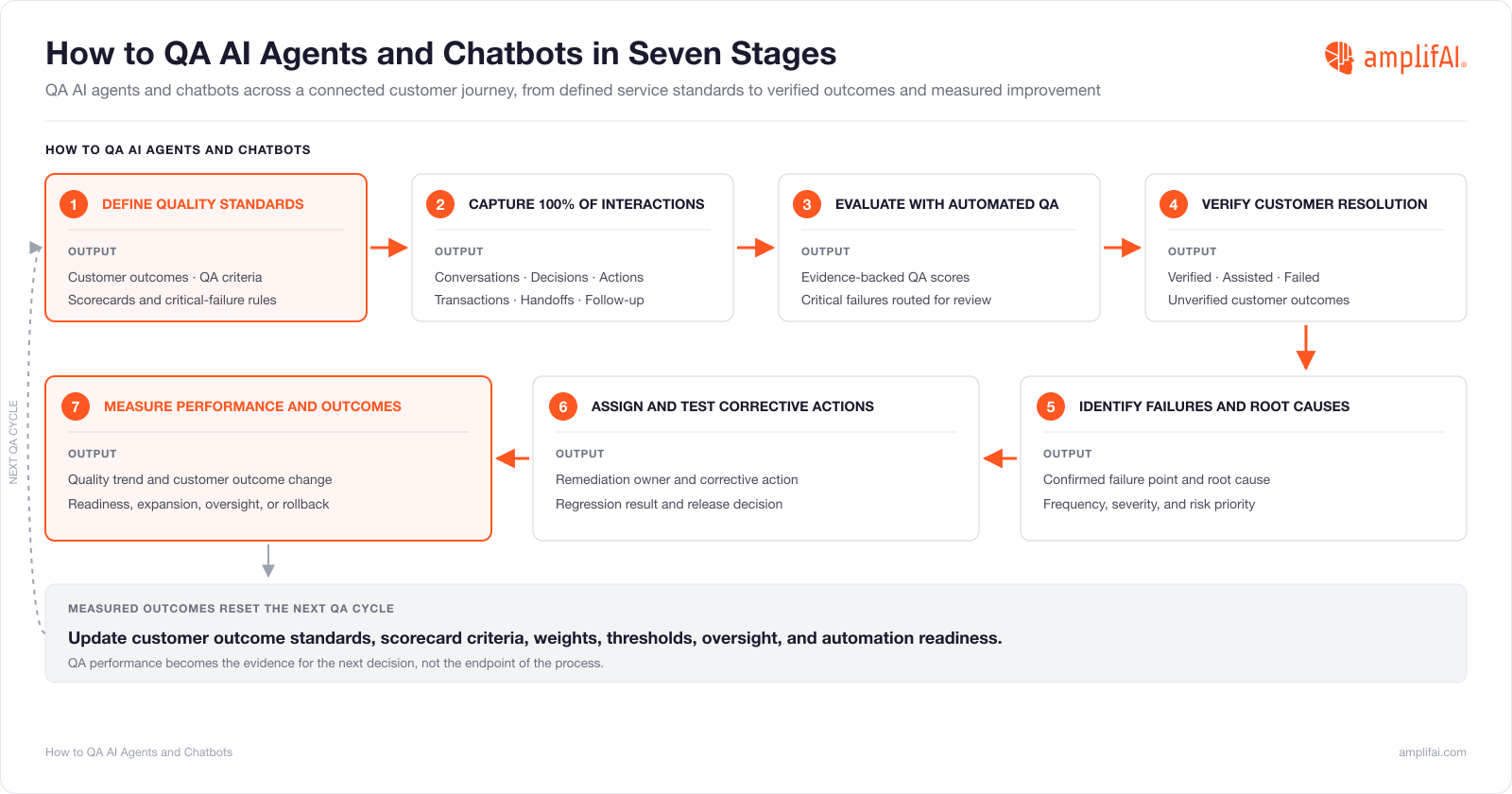
We've covered how to QA AI agents and chatbots in seven steps, from defining quality standards to measuring performance and customer outcomes across AI and live teams:
- Define QA Standards for AI Agents and Chatbots by establishing successful customer outcomes, AI-specific evaluation criteria, and measurable QA scorecards.
- Capture 100% of AI Agent, Chatbot, and Self-Service Interactions with complete conversation, decision, workflow, transaction, and handoff records.
- Use Automated QA to Evaluate AI Agent and Chatbot Performance, scoring accuracy, compliance, decision quality, and escalation through calibrated evaluations.
- Verify AI Agent and Chatbot Customer Resolution against business records, repeat contacts, and live-agent interactions.
- Identify AI Agent Quality Failures and Root Causes by investigating recurring errors, tracing failures to their source, and prioritizing customer and business risk.
- Assign AI Agent and Chatbot Corrective Actions to the responsible teams, correct the underlying failures, and validate changes before deployment.
- Measure AI Agent QA Performance and Customer Outcomes by tracking quality improvement, comparing AI and live-agent performance, and establishing automation readiness.
QA requirements for AI agents and chatbots differ by industry, contact center size, customer request complexity, and AI autonomy. Even though a retail chatbot answering delivery questions and a financial services AI agent processing account changes face different compliance requirements and business risks, both need quality assurance that establishes what the automation delivered, where service failed, and whether corrective actions improved customer outcomes.
Topics covered:
- Define QA Standards for AI Agents and Chatbots
- Capture 100% of AI Agent, Chatbot, and Self-Service Interactions
- Use Automated QA to Evaluate AI Agent and Chatbot Performance
- Verify AI Agent and Chatbot Customer Resolution
- Identify AI Agent Quality Failures and Root Causes
- Assign AI Agent and Chatbot Corrective Actions
- Measure AI Agent QA Performance and Customer Outcomes
- How AI Agent QA Software Needs to Evaluate the Complete Customer Journey
- QA for AI Agents and Chatbots Is a Necessity for 2027
If you haven't read our latest reports, start with why you don't know if your chatbots are working and how AI agents are augmenting live-agent workforces rather than replacing them.
Define QA Standards for AI Agents and Chatbots
QA for AI agents and chatbots starts with defining what successful service looks like for the customer. A small ecommerce contact center answering order-status questions and an enterprise financial services contact center using AI agents for account changes require different evaluation criteria, compliance controls, and levels of oversight, while both remain accountable to shared customer outcomes, including accurate information, completed requests, and appropriate escalation. Gartner's September 2026 research recommends holding AI-driven and human-assisted service accountable to shared customer outcomes, with evaluation criteria accounting for how AI agents make decisions, execute workflows, and handle customer requests.
| Quality Standard | What Successful AI Service Looks Like | What QA Evaluates | Why It Matters |
|---|---|---|---|
| Customer Intent | AI correctly identifies the reason for contact, understands customer context, and confirms ambiguous requests before taking action. | Intent recognition accuracy, topic classification, contextual relevance, and request confirmation. | Misunderstood requests lead to incorrect answers, unnecessary workflows, and avoidable transfers. |
| Accuracy and Compliance | AI delivers accurate, policy-aligned information, follows required authentication and disclosure procedures, and stays within authorized commitments. | Factual accuracy, knowledge grounding, hallucinations, policy adherence, required disclosures, and compliance violations. | Inaccurate responses and unauthorized actions expose customers and companies to service failures and compliance risk. |
| Decision and Action Quality | AI selects the correct workflows and APIs, follows approved instructions, and interprets execution results accurately. | API selection accuracy, decision quality, workflow execution, guardrail adherence, and action confirmation. | Incorrect decisions and failed actions create service failures even when the AI response appears correct. |
| Resolution Completeness | AI completes the customer's requested service, accurately communicates the result, or initiates the appropriate escalation when live assistance is required. | QA verifies completion of the customer request, outcome accuracy, customer confirmation, and required follow-through. | Completed sessions and reported resolutions can conceal unfinished requests and failed customer outcomes. |
| Escalation and Handoffs | AI recognizes when live assistance is necessary, escalates at the appropriate point, and transfers relevant customer context and completed actions. | Escalation appropriateness, timing, routing accuracy, containment judgment, and context transfer. | Delayed escalations and incomplete handoffs increase customer effort, repeat discovery, and resolution time. |
| Customer Effort and Experience | AI recognizes customer frustration, asks relevant questions, maintains brand standards, and provides guidance appropriate to the request. | Customer effort, friction detection, sentiment response, conversational relevance, and brand adherence. | Repetitive questions, irrelevant guidance, and circular self-service journeys increase frustration and abandonment. |
| Interaction Documentation | AI accurately records contact reasons, actions taken, workflow results, escalation details, and reported outcomes in customer service records. | Contact reason accuracy, outcome logging, case documentation, and interaction classification. | Incorrect records distort quality reporting, customer journey analysis, and subsequent service decisions. |
| Use AI agent and chatbot quality assurance standards as the shared framework for AI and live-agent service, then adapt the criteria and scoring rules to your industry's requirements, customer service use cases, and AI decision authority. | |||
Establish Customer Outcome Standards for AI and Live Agents
Start with the contact reasons your AI agents, chatbots, and live teams handle, then define the outcome the customer should receive for the request. An order-status inquiry requires accurate delivery information, while a refund request requires the authorized transaction to take effect or an appropriate handoff when the AI can't complete the request. For those interactions, establish the expected result, acceptable escalation path, customer effort, and evidence required to confirm completion. Hold AI and live-agent service to shared customer outcome standards, distinguishing a correctly executed handoff from a resolved issue so the QA program doesn't count a transfer as a completed customer request.
Adapt AI Agent and Chatbot QA Criteria by Use Case
Adapt AI agent and chatbot QA criteria to the customer request, industry requirements, and decisions the automation is authorized to make. A retail chatbot answering shipping questions needs criteria for information accuracy and appropriate escalation, while a financial services AI agent updating account details requires additional controls for identity verification, authorization, data handling, and execution confirmation. Healthcare, insurance, and BPO environments introduce further compliance requirements, client policies, and service expectations. Map the customer intents and workflows assigned to your AI agents and chatbots, identify where incorrect responses or autonomous actions introduce customer or business risk, and establish the evaluation criteria required for those interactions.
Build AI Agent and Chatbot QA Scorecards
Build AI agent and chatbot QA scorecards from defined customer outcomes and evaluation criteria, with measurable scoring rules, weights, pass/fail thresholds, and critical-failure conditions matched to the service being delivered. Define what constitutes acceptable performance for intent recognition, response accuracy, compliance adherence, decision quality, workflow execution, and escalation, with scoring requirements tied to verifiable interaction evidence. Apply greater weight to criteria carrying higher customer or business risk, and establish automatic failures for serious violations such as unauthorized account changes, missed regulatory disclosures, or prohibited commitments, regardless of the overall QA score. Completed scorecards define the interaction, decision, workflow, and outcome evidence QA teams must capture before evaluation begins.
Capture 100% of AI Agent, Chatbot, and Self-Service Interactions
Capture 100% of interactions across automated service channels, preserving the timestamps, session identifiers, AI decisions, tool calls, and handoff records needed to connect customer activity with CRM and transaction data. AI agent and chatbot quality assurance requires a complete record of automated customer interactions, including conversations, IVR journeys, self-service workflows, and requests that end in abandonment, errors, or live-agent transfers. A conversation transcript records what the AI told the customer, while workflow and transaction records establish what the automation attempted and what the business systems recorded.
Identify AI Agent, Chatbot, and Self-Service Data Sources
Identify the AI agents, chatbots, voice assistants, and IVR applications handling customer requests, including the vendors and service channels responsible for generating interaction data. Map the data sources for your automated service deployments, documenting available records, data formats, API or export access, retention periods, and teams responsible for data access.
| Interaction or Data Source | What to Capture or Extract | QA Purpose |
|---|---|---|
| AI Chatbot Conversations | Complete conversation transcripts, customer messages, AI responses, detected intents, session IDs, timestamps, and reported outcomes. | Evaluate conversation accuracy, intent understanding, response quality, and adherence to service standards. |
| Voice AI and Virtual Agents | Call recordings, speech transcripts, recognized intents, interruptions, silence, recognition failures, and transfer events. | Assess voice interaction quality, speech recognition accuracy, customer understanding, and escalation behaviour. |
| IVR and Automated Self-Service | IVR menu selections, authentication results, navigation paths, retries, abandonment events, task completion statuses, and session identifiers. | Reconstruct automated service journeys, including menu-driven interactions and self-service requests that produce no conversation transcript. |
| AI Agent Decisions and Actions | Tool selections, API calls, workflow steps, execution timestamps, returned statuses, error messages, and decision records. | Evaluate autonomous decision quality, workflow execution, tool selection, and whether AI actions followed the authorized service process. |
| Knowledge and Response Sources | Retrieved knowledge articles, source identifiers, content versions, policy references, and information supplied to the AI during the interaction. | Establish which information informed AI responses and provide evidence for evaluating factual accuracy, knowledge grounding, and policy adherence. |
| Escalations and Live-Agent Handoffs | Escalation triggers, transfer timing, routing destinations, interaction summaries, transferred customer context, and linked live-agent interaction IDs. | Evaluate escalation decisions, handoff completeness, routing accuracy, and service continuity between AI agents and live teams. |
| CRM and Business Transactions | Customer and case identifiers, account updates, order statuses, refund records, transaction references, workflow results, and completion statuses. | Connect automated service activity with customer records and business actions required for outcome verification. |
| Customer Feedback and Subsequent Contacts | CSAT responses, customer complaints, survey comments, repeat contacts, reopened cases, channel changes, and subsequent interaction timestamps. | Connect automated interactions with customer feedback and later service activity to support resolution and customer journey analysis. |
| Apply privacy, access, and retention controls to customer records, recordings, and sensitive transaction data while preserving the identifiers needed to connect failed, abandoned, and escalated interactions. | ||
Connect AI Interaction Data Across Customer Service Systems
Connect AI agent, chatbot, IVR, and live-agent interaction records using shared customer, session, case, and transaction identifiers, preserving timestamps and channel transitions across automated workflows and handoffs. Match chatbot session IDs with CCaaS interaction records, CRM case histories, API execution logs, and transaction references to establish a continuous customer journey across service channels.
When customer requests span multiple sessions or customer service systems use different identifiers, establish matching rules using account information, contact reasons, and interaction timestamps, flagging uncertain matches for review. Preserve the sequence of customer requests, AI decisions, workflow actions, and transfers so QA teams can trace service activity from the original contact through subsequent interactions and related business records.
Verify AI Agent Interaction Capture and Data Completeness
Verify AI agent, chatbot, IVR, and self-service data completeness by reconciling captured interactions against source-system activity logs, including completed, abandoned, failed, and transferred sessions. Check ingestion timestamps, duplicate records, missing transcripts, incomplete event sequences, and broken customer or transaction identifiers, distinguishing records missing at the source from data lost during extraction or integration. Use exception reports to monitor interaction capture rates by service channel, AI application, customer intent, and reporting period, identifying data gaps, ingestion failures, and incomplete interaction histories that require correction before automated QA scoring begins.
Use Automated QA to Evaluate AI Agent and Chatbot Performance
Use automated QA software capable of evaluating AI agent, chatbot, and self-service interactions against the quality scorecards established for the service being delivered. Score how automation identifies customer intent, follows policy, selects workflows, executes actions, and handles escalation. A compliant response doesn't excuse an unauthorized action, and live-agent completion doesn't make an appropriate transfer a failed AI interaction. QA analysts use evidence-backed evaluations tied to exact responses, events, and actions to confirm critical failures and calibrate automated scores for compliance, conversation quality, and AI decision-making.
Configure Automated QA Evaluations by AI Agent and Use Case
Configure automated QA evaluations for the customer intents, workflows, and service channels handled by your AI agents, chatbots, and IVR applications, assigning scorecards and scoring rules by use case. Apply compliance checks, critical-failure conditions, and evaluation weights according to service requirements, with scoring criteria matched to informational requests, authenticated account changes, financial transactions, and live-agent escalations. Set evaluation triggers for policy violations, unauthorized actions, failed workflows, and escalation errors to route high-risk findings for QA analyst review and maintain consistent scoring across comparable interactions.
Score AI Agent Interactions for Accuracy, Compliance, and Decision Quality
Score AI agent and chatbot interactions using conversation transcripts, retrieved knowledge, IVR event histories, and workflow execution logs to evaluate what automation said and did against the applicable QA criteria. Monitor factual accuracy, policy adherence, required disclosures, authentication procedures, prohibited commitments, hallucinations, and guardrail violations against the policies and knowledge sources in effect during the interaction.
Evaluate autonomous decisions by comparing customer requests with tool selections, API parameters, execution results, and AI confirmations. Score IVR navigation and authentication events where no conversation transcript exists. Assess escalation judgment, transfer timing, and handoff context, recording pass, fail, and critical-failure findings against specific interaction events and supporting evidence.
| AI Interaction Event | Automated QA Evaluation | Evidence Evaluated |
|---|---|---|
| Customer requests an account change | Did AI identify the correct intent? | Customer message and detected intent |
| AI requests account verification | Did AI follow authentication policy? | Conversation transcript and authentication result |
| AI invokes an account update workflow | Did AI select the correct action? | Tool call, API parameters, and execution result |
| AI confirms the requested change | Did AI accurately communicate the action? | AI response and execution record |
Calibrate Automated QA Scores and Review Critical Failures
Calibrate automated QA scores against QA analyst scores for a representative interaction sample, including passing interactions, borderline scores, and known compliance or execution failures. Compare scoring disagreements by evaluation criterion, customer intent, and AI application, identifying missed violations, false-positive findings, and inconsistent scoring before adjusting evaluation rules, thresholds, or evidence requirements. Prioritize critical failures for QA analyst review, documenting confirmed violations and escalation requirements according to customer and business risk. Repeat calibration following scorecard changes, AI updates, or shifts in interaction volume and complexity, tracking scoring agreement and missed critical failures to maintain evaluation accuracy at scale.
Verify AI Agent and Chatbot Customer Resolution
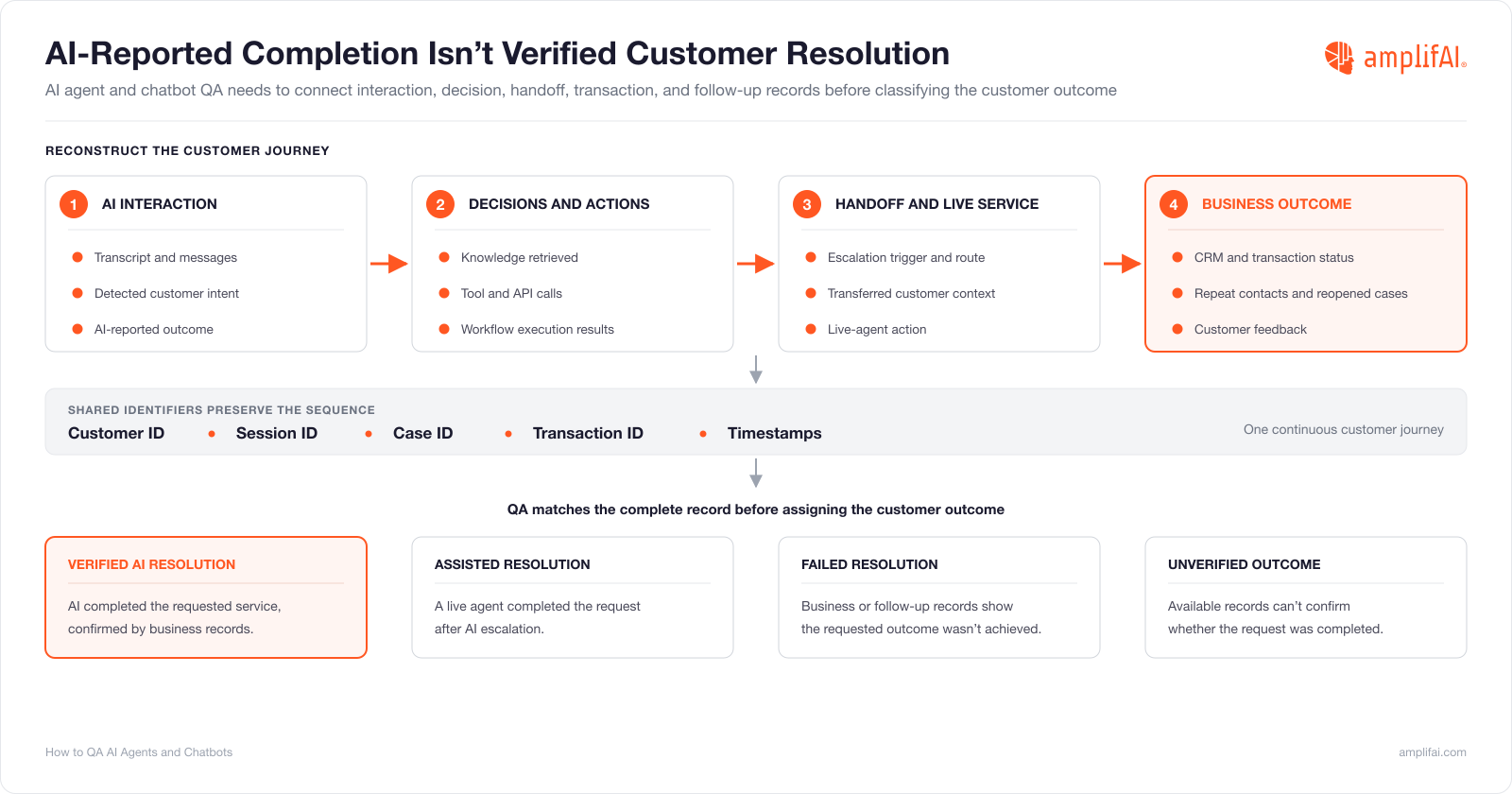
Verify AI agent and chatbot customer resolution against the customer's requested outcome, using CRM records, transaction confirmations, repeat-contact histories, and live-agent interactions to establish what happened after automated service ended. A chatbot can report a completed request while the transaction fails, the account remains unchanged, or the customer returns to support with the original issue unresolved. Match AI-reported outcomes against the customer journey and supporting business records, distinguishing verified AI resolution, assisted resolution, failed resolution, and unverified outcomes. QA teams need to distinguish what the AI agent completed, what the live agent resolved after escalation, and whether the customer received the intended result.
| AI-Reported Outcome | Verification Evidence | QA Finding | Resolution Classification |
|---|---|---|---|
| AI agent confirms a refund was processed. | Transaction records confirm the authorized refund completed successfully. | Customer received the requested refund. | Verified AI Resolution |
| Chatbot reports a successful escalation. | Live-agent interaction and CRM records confirm the agent completed the customer's request. | Customer received the intended resolution through live-agent assistance. | Assisted Resolution |
| AI agent confirms an account update. | CRM records show the wrong account information was changed. | Requested account change was completed incorrectly. | Failed Resolution |
| Chatbot closes an interaction as resolved. | Subsequent contact records confirm the customer contacted support again with their issue unresolved. | Customer required additional service for the original request. | Failed Resolution |
| AI agent reports a completed transaction. | Transaction confirmation is missing or can't be matched to the customer request. | Available records don't establish whether the transaction succeeded. | Unverified Outcome |
| Classify customer outcomes using verified service and business records. Record AI-only resolution separately from assisted resolution, distinguish confirmed failures from missing evidence, and retain the original customer intent when tracking subsequent interactions. | |||
Validate AI Agent Actions Against Customer and Transaction Records
Reconcile AI-reported completion with the customer's original request by matching customer identifiers, case numbers, workflow references, and timestamps in the applicable CRM, account, order-management, or transaction records. Verify the requested action against the system of record, distinguishing a submitted or accepted API request from a completed transaction or applied account change. Compare the executed action with the customer's authorization, requested changes, and confirmation provided by the AI agent. Classify confirmed discrepancies as failed resolutions and missing or insufficient evidence as unverified outcomes, preserving the supporting records for QA review.
Track Repeat Contacts, Channel Switching, and Unresolved Issues
Track repeat contacts and channel changes following AI agent and chatbot interactions, establishing follow-up windows appropriate to the customer request and expected resolution time. Match subsequent calls, chats, emails, and reopened cases to the original customer intent, distinguishing unrelated service requests from return contacts triggered by unresolved issues, incorrect answers, or actions the AI promised but didn't complete. Record the number of additional contacts, elapsed time between interactions, channels used, and eventual resolution status, identifying where customers abandoned self-service, repeated their request, or required further assistance after the AI reported completion.
Verify AI-to-Live-Agent Handoffs and Final Resolution
Verify AI-to-live-agent handoffs by matching escalation records with the receiving agent's interaction, including transfer timing, routing destination, customer intent, conversation history, and actions the AI agent completed before transfer. Review whether the live agent received accurate context, had to repeat discovery or authentication, and completed the original customer request. Trace the final resolution through CRM updates, transaction records, and subsequent contact activity, distinguishing appropriate AI escalations from failed transfers and unresolved requests. Attribute what the AI agent completed separately from what the live agent resolved while maintaining one verified customer outcome across the service journey.
Identify AI Agent Quality Failures and Root Causes
Use AI agent and chatbot QA findings to investigate recurring quality failures by customer intent, service channel, workflow, and severity, distinguishing isolated errors from problems affecting larger interaction volumes. Incorrect account-change confirmations can originate from faulty intent recognition, outdated knowledge, wrong tool selection, failed API execution, or misinterpreted transaction statuses, with similar customer-facing failures requiring different investigations. Compare QA findings against decision logs, knowledge versions, workflow records, and verified customer outcomes to establish root causes and prioritize confirmed issues by frequency, customer impact, and compliance exposure.
| Quality Failure | Evidence to Examine | Potential Root Cause | How to Confirm the Root Cause |
|---|---|---|---|
| Incorrect Customer Intent | Customer request, intent classification, conversation context, and clarification history. | Intent recognition errors, incorrect classification, or missing customer context. | Compare the customer's stated request with the detected intent and subsequent AI decisions. Review misclassified interactions to identify recurring recognition or context errors. |
| Inaccurate Policy Information | AI response, retrieved knowledge, source references, and policy versions. | Outdated knowledge, incorrect retrieval, missing source content, or faulty AI instructions. | Compare the response and retrieved sources against the policy in effect during the interaction. Determine whether the error originated in source content, retrieval, or AI interpretation. |
| Wrong Workflow Executed | Customer request, selected tools, API parameters, workflow steps, and execution logs. | Incorrect tool selection, workflow configuration, or AI decision logic. | Trace the requested action through tool selection and execution records. Identify the decision or workflow step that diverged from the authorized process. |
| Failed IVR Self-Service Journey | Menu navigation, authentication attempts, recognition failures, retries, and transfer events. | Routing errors, authentication failures, recognition problems, or broken self-service paths. | Reconstruct the customer's IVR path and compare recorded events against the intended call flow. Identify where navigation, authentication, or routing failed. |
| Incorrect Escalation | Escalation triggers, customer sentiment, routing decisions, transfer timing, and handoff context. | Incorrect escalation thresholds, routing logic, or handoff configuration. | Compare escalation decisions with the applicable service rules and interaction evidence. Confirm whether the AI escalated at the required point and transferred the correct context. |
| False-Positive Resolution | AI confirmation, transaction status, CRM outcome, workflow responses, and outcome logs. | Failed execution, incorrect status interpretation, or inaccurate outcome recording. | Trace the confirmed resolution failure to the workflow and reporting records. Determine whether execution failed, the AI misinterpreted the result, or the interaction was incorrectly marked as resolved. |
Identify Recurring AI Agent Errors and Quality Patterns
Segment AI agent and chatbot QA findings by customer intent, service channel, workflow, AI application, and failure type, calculating error rates against the interaction volumes eligible for matching evaluation criteria. Compare quality trends across reporting periods, AI deployments, and customer request complexity, distinguishing isolated failures from recurring errors and changes caused by shifts in interaction volume or service mix. Group related failures into identifiable patterns, recording affected interaction volume, frequency changes, and supporting records to establish where intent recognition, compliance, decision-making, or workflow execution errors recur.
Trace AI Agent Failures to Knowledge, Decisions, and Workflow Execution
Trace AI agent and chatbot quality failures through the sequence of customer intent, retrieved knowledge, AI decisions, workflow execution, and recorded outcomes, identifying where service first deviated from the authorized request or expected behaviour. Compare time-aligned interaction records and decision logs with the knowledge, prompt, or workflow configurations active during the session to distinguish the originating failure from subsequent errors. An incorrect account change caused by misclassified intent requires a different diagnosis from a correctly selected workflow rejected by the transaction system. Document the confirmed failure point, supporting evidence, affected AI configurations, and conditions required to reproduce the error.
Prioritize AI Agent Quality Failures by Customer and Business Impact
Prioritize confirmed AI agent and chatbot quality failures by severity, frequency, affected interaction volume, and exposure to customer, compliance, and financial risk. Critical failures involving unauthorized transactions, regulatory violations, or sensitive customer information require immediate escalation, while recurring intent recognition errors, incomplete handoffs, and failed self-service workflows need assessment against customer effort, repeat contacts, and unresolved requests. Rank findings using verified QA evidence and customer outcomes, documenting the root cause, affected use cases, failure frequency, and business impact so corrective actions address the highest-risk issues first.
Assign AI Agent and Chatbot Corrective Actions
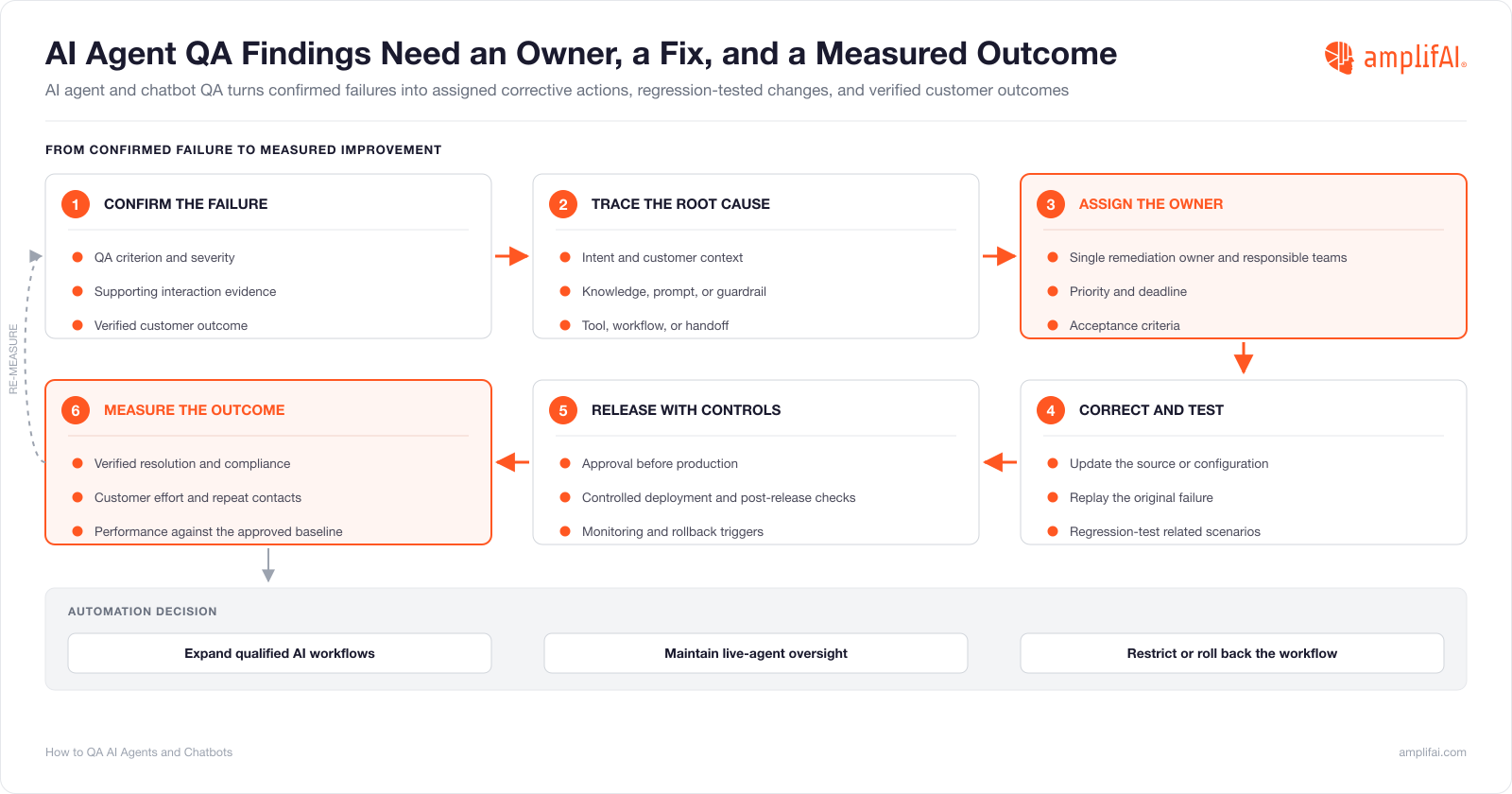
Assign confirmed AI agent and chatbot QA failures to the teams responsible for correcting them, separating customer service quality accountability from technical remediation. QA and compliance leaders establish the required service outcome, while AI engineering, IT, knowledge management, and contact center teams address the underlying causes through changes to knowledge sources, prompts, workflows, integrations, and escalation rules. Document corrective actions with assigned owners, priorities, deadlines, and validation requirements, escalating critical compliance violations or unauthorized actions for immediate intervention. Test corrections against the original failure and related customer scenarios before returning affected AI workflows to production.
| QA Finding | Responsible Team | Corrective Action | Validation Requirement |
|---|---|---|---|
| Outdated policy responses | Knowledge management and AI engineering | Update source content and retrieval configuration | Confirm correct policy retrieval and response accuracy |
| Incorrect tool selection | AI engineering | Adjust tool instructions, selection logic, or orchestration | Confirm correct tool selection across affected scenarios |
| Repeated compliance violations | Quality, compliance, and AI engineering | Correct guardrails and required-response logic | Confirm compliance against applicable rules |
| Incomplete live-agent handoffs | Contact center teams and AI engineering | Correct escalation triggers and context transfer | Confirm accurate routing and transferred customer context |
| Failed transaction execution | IT, integrations, and AI engineering | Correct workflow or API execution failures | Confirm successful execution and accurate status reporting |
Assign AI Agent QA Findings to the Right Teams
Route confirmed AI agent and chatbot QA findings to the teams responsible for the affected service component, with QA and compliance leaders retaining accountability for customer outcomes and service standards. Assign a single remediation owner when multiple teams contribute to a failure, establishing clear responsibility for investigation, corrective action, and validation. Use severity-based response deadlines and escalation procedures for compliance violations, unauthorized actions, and failures affecting large customer volumes, including temporary workflow restrictions when customer risk requires immediate intervention. Track remediation status, supporting QA evidence, and ownership changes through a shared corrective-action workflow, with quality teams confirming the acceptance criteria required to close the finding.
Correct AI Agent Knowledge, Prompts, Workflows, and Escalation Rules
Apply corrective actions to the knowledge sources, prompts, decision rules, workflows, and integrations identified in the root cause investigation. Update outdated knowledge articles and retrieval configurations when AI agents provide incorrect policy information, adjust prompts and guardrails for unauthorized commitments, and correct tool-selection logic, API parameters, or transaction-status handling when autonomous actions fail. For escalation failures, revise transfer triggers and routing rules, then correct the customer context transferred to live agents, including conversation history, verified intent, and completed actions. Document configuration changes, affected use cases, and policy requirements, maintaining version histories that support regression testing and compliance audits.
Test AI Agent Corrections Before Deployment
Test AI agent and chatbot corrections against the original failed interaction, related customer intents, and exception scenarios, verifying that updated knowledge, prompts, workflows, and escalation rules produce the required service outcomes. Conduct simulated customer conversations and regression tests covering authorized transactions, authentication failures, policy restrictions, API errors, and live-agent handoffs, checking for unintended changes to previously successful workflows. Compare test results against the applicable QA scorecards and critical-failure conditions, documenting failed scenarios, required adjustments, and approval decisions before releasing changes to production. Use controlled deployments and post-release checks to confirm that corrected AI behaviour remains consistent in live customer interactions.
Measure AI Agent QA Performance and Customer Outcomes
Measure AI agent and chatbot QA performance against established service baselines, tracking whether corrective actions improve verified resolution, compliance adherence, customer effort, and cost per resolved request. Compare performance across consistent reporting periods, customer intents, and service complexity, distinguishing AI-only resolutions from assisted and live-agent outcomes. Evaluate quality scores alongside repeat contacts, customer feedback, transaction results, and compliance failures to establish whether performance improvements reach the customer. Use sustained quality performance, customer outcomes, and business results to determine which automated workflows are ready for expansion, require additional oversight, or need further improvement.
| QA Measurement | What to Measure | Evidence and Comparison | What to Do With the Results |
|---|---|---|---|
| Customer Resolution | Verified AI resolution rate, assisted resolution rate, failed requests, and unresolved outcomes. | Compare confirmed resolutions against eligible requests, using CRM, transaction, and subsequent contact records. | Identify customer intents with low resolution rates, determine which workflows require improvement, and separate successful automation from requests requiring live-agent assistance. |
| Quality and Compliance | QA scores, policy adherence, factual accuracy, critical-failure rates, and decision quality. | Track scorecard results against established quality thresholds, comparing equivalent customer intents and reporting periods. | Escalate recurring compliance failures, review affected AI workflows, and determine whether quality meets the standards required for continued deployment. |
| Customer Experience | CSAT, customer effort, repeat-contact rates, abandonment, and unnecessary transfers. | Connect customer feedback and subsequent interactions to the original request, using consistent follow-up windows. | Identify automated journeys creating customer friction and prioritize improvements according to affected customer volumes and service impact. |
| AI and Live-Agent Performance | Resolution quality, comparable QA scores, escalation outcomes, and service performance by customer intent. | Compare AI and live-agent interactions with similar request complexity, using shared customer outcome standards and role-specific evaluation criteria. | Identify requests suitable for AI-only resolution, workflows requiring live-agent assistance, and performance gaps affecting the complete customer journey. |
| Cost and Efficiency | Cost per verified resolution, repeat-service costs, assisted resolution costs, and automation efficiency. | Combine AI service costs with related live-agent handling, repeat contacts, and transaction outcomes, calculating cost against verified resolutions. | Determine whether automation reduces the total cost of resolving customer requests and where additional service effort offsets efficiency gains. |
| Corrective Action Effectiveness | Quality score changes, recurring failures, verified resolution improvement, and sustained compliance performance. | Compare equivalent interaction populations before and after corrective actions, tracking performance over subsequent reporting periods. | Confirm whether corrections improved customer outcomes, identify recurring problems, and determine which AI workflows meet the requirements for expanded automation. |
Track AI Agent Quality Scores and Customer Outcomes Over Time
Establish a baseline reporting period and calculate AI agent and chatbot QA pass rates, critical-failure rates, and verified resolution rates using consistent definitions and eligible interaction volumes. Keep assisted resolutions, failed requests, and unverified outcomes visible as separate classifications to prevent incomplete records or changes in automation volume from distorting performance. Compare results before and after corrective actions by customer intent, workflow, service channel, and request complexity, maintaining consistent scorecard criteria and follow-up windows. Track performance across successive reporting periods, identifying sustained improvements, recurring failures, and changes in customer outcomes that require further investigation.
Compare AI Agent and Live-Agent Service Performance
Compare AI agent and live-agent performance against shared customer outcome standards, matching interactions by customer intent, request complexity, service channel, and resolution requirements. Use role-specific QA scorecards to evaluate AI decision quality and live-agent service behaviours, while measuring resolution accuracy, compliance adherence, customer effort, and final outcomes against shared service expectations. Separate AI-only resolutions from requests completed through live-agent assistance, accounting for actions completed during automated service and by live agents after handoff. Analyze performance differences by use case to identify where AI delivers comparable service quality, where live agents achieve stronger outcomes, and which customer requests require a combination of automated and live assistance.
Use AI Agent QA Results to Guide Automation Improvements and Expansion
Establish automation readiness criteria for customer intents and workflows, requiring sustained resolution quality, compliance adherence, acceptable customer effort, and performance against defined risk thresholds before expanding AI responsibilities. Keep high-risk requests, recurring quality failures, and interactions requiring complex judgment under live-agent oversight until automated service meets the required standards. Expand qualified AI use cases through controlled deployments, monitoring customer outcomes as interaction volumes, request complexity, and autonomous decision-making increase. Set escalation and rollback triggers for compliance violations, failed transactions, rising repeat contacts, or declining resolution rates, reviewing performance against the approved quality baseline before expanding automation further.
How AI Agent QA Software Needs to Evaluate the Complete Customer Journey
Evaluating AI agents, chatbots, IVR, and live-agent interactions manually requires QA teams to reconstruct customer journeys across conversations, workflow records, transactions, and service outcomes, making continuous quality assurance impractical at scale. Contact centers have traditionally relied on two pathways for AI agent and chatbot QA, either CCaaS reporting or dedicated quality management software that keeps AI and live-agent QA separate.
Gartner presents AmplifAI's AI-Human Performance Comparison as a third approach in their September 2026 report, How Service QA Should Evaluate AI-Driven Customer Interactions, modelling how AmplifAI evaluates AI and live-agent service against shared customer outcomes with criteria matched to their different responsibilities in delivering service.
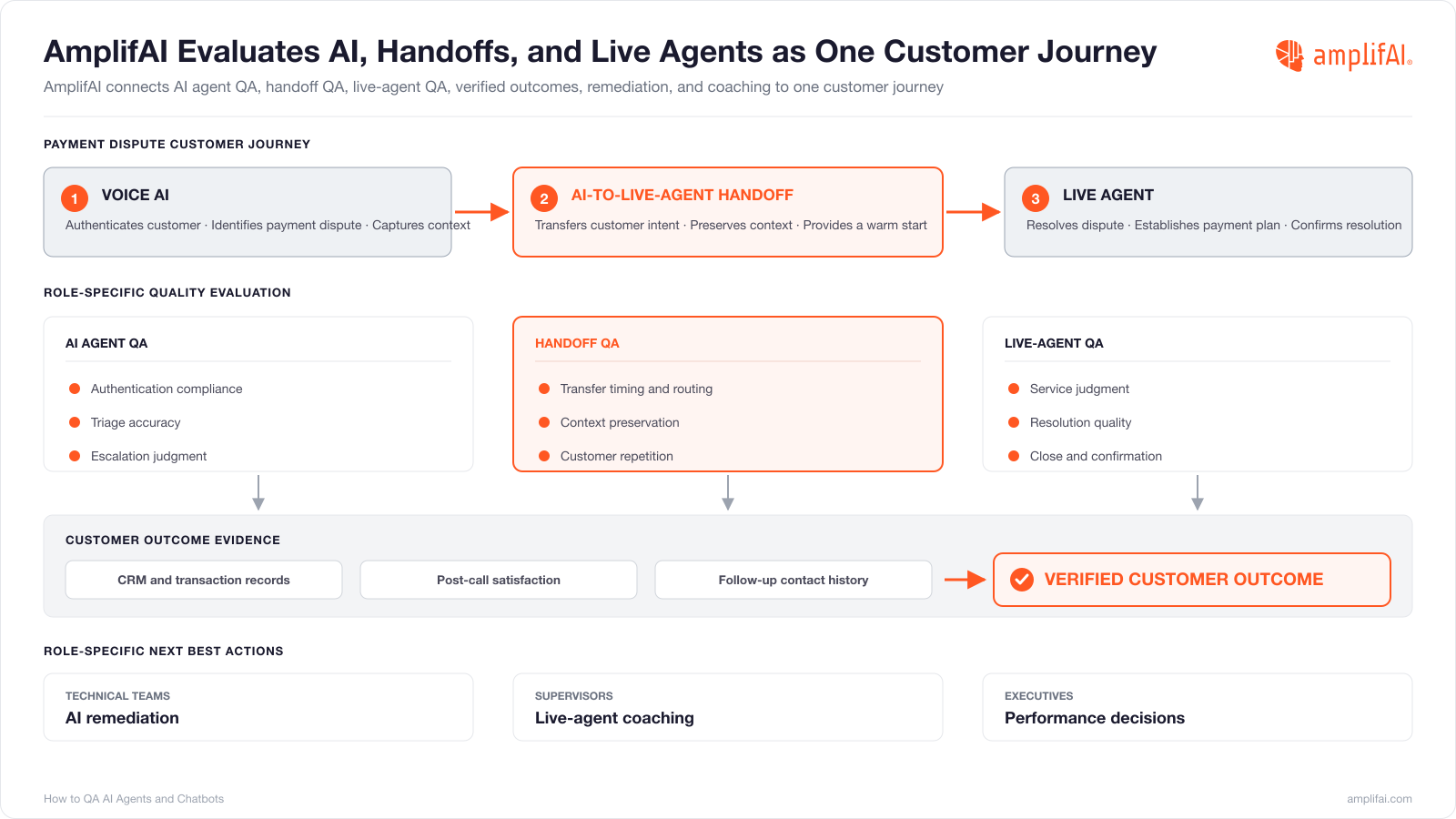
Evaluate AI Agent and Live-Agent Quality Across the Customer Journey
Gartner's payment-dispute example shows AmplifAI evaluating one customer journey handled by voice AI and a live agent. Voice AI authenticates the customer, identifies the payment dispute, and transfers context to a live agent who resolves the dispute and establishes a payment plan. AmplifAI scores the AI interaction for authentication, triage accuracy, and escalation judgment, evaluates the handoff for context preservation and customer repetition, and measures live-agent judgment and resolution quality against shared customer outcome standards. AmplifAI combines AI, handoff, and live-agent evaluations with post-call satisfaction and follow-up contact history in one customer journey, establishing whether the customer received the intended resolution.
Connect AI Agent Remediation and Live-Agent Coaching to Customer Outcomes
AmplifAI uses unified customer interaction and performance data to identify quality failures across AI agents and live teams, delivering role-specific next best actions to frontline agents, supervisors, technical teams, and executives. AI agent failures involving incorrect decisions, knowledge retrieval, workflow execution, or escalation generate recommended actions for the technical teams responsible for remediation, while live-agent performance insights guide supervisors on who to coach, what to coach, and how, informing simulation training, recognition, and follow-up. AmplifAI powers AI-native quality assurance and performance management workflows across both AI agents and live teams, tracking corrective actions and measuring coaching effectiveness alongside subsequent AI agent QA results. Verified customer resolution, compliance, customer effort, and business outcomes establish whether AI remediation and live-agent development produced measurable improvements.
QA for AI Agents and Chatbots Is a Necessity for 2027
QA for AI agents and chatbots is a necessity for 2027 as companies are deploying increasingly capable AI across hybrid service workforces faster than their quality assurance and performance management practices are advancing.
The seven stages of QA for AI agents and chatbots we've outlined in this article are the blueprint for what QA automation software needs to do.
Contact centers need QA automation software capable of unifying customer interaction and performance data, evaluating AI and live-agent service against shared customer outcomes, delivering role-specific corrective actions, and measuring whether those actions improve business outcomes across your organization.
For a closer look at QA automation software for AI agents and chatbots, explore our 2027 guide to the top call center quality assurance software providers or speak with one of our contact center leaders at AmplifAI.