
10 Best Contact Center as a Service (CCaaS) Software (2026)
- Published:
- Updated:
- Authored by
-
 Richard James Director of Organic Growth and CX
 - Reviewed by
-
 Sean Minter Founder, CEO
Contact Center as a Service (CCaaS) software delivers telephony, omnichannel routing, and IVR self-service as cloud infrastructure, connecting customer interactions on voice, chat, email, SMS, social, and messaging channels to agents through a unified routing engine. CX leaders and contact center supervisors use CCaaS software to route customers by skill and priority, manage queue coverage and service levels, and scale agent capacity with demand.
Our team of CX specialists reviewed and ranked the 10 best Contact Center as a Service (CCaaS) software vendors of 2026 based on coverage across CCaaS software types, features, and evaluation criteria:
When evaluating CCaaS vendors, focus on communications breadth, routing intelligence, AI maturity, WFM and QM depth, and integration openness, including how freely interaction data flows to the quality, coaching, and performance management software layer where your contact center teams act on it. Start your comparison in the sections below:
- Types of Contact Center as a Service (CCaaS) Software: Where full-suite, cloud-native, UCaaS + CCaaS, API-first, and AI-native CCaaS fit across contact center sizes, existing communications software, and developer resources.
- Contact Center as a Service (CCaaS) Software Features: Which capabilities to compare vendors against your routing, voice quality, AI, WFM and QM, self-service, and integration requirements.
- Contact Center as a Service (CCaaS) Software Evaluation Criteria: How to test vendor claims against your channel mix, interaction volumes, existing software, and budget.
CCaaS Data Integration and Performance Management: CCaaS interaction data gains value when call recordings, transcripts, routing outcomes, and handle times can be measured against service quality, customer outcomes, and agent performance. Unified CX and performance management software like AmplifAI unifies interaction data from any CCaaS provider with quality, survey, and business data into one performance layer above the infrastructure.
Compare the Best Contact Center as a Service (CCaaS) Software of 2026
Compare the 10 best Contact Center as a Service (CCaaS) software vendors of 2026, ranked on documented CCaaS capability coverage together with software architecture, WFM and QM depth, integration openness, implementation requirements, and best-fit use cases.
| Rank | CCaaS Software | Best Fit | CCaaS Capability Coverage |
|---|---|---|---|
| 1 | NICE CXone | Enterprise contact centers bundling routing, WFM, quality management, and analytics inside NICE CXone | 100% |
| 2 | Genesys Cloud CX | Enterprise contact centers routing customers on AI predictions of resolution likelihood and customer satisfaction | 100% |
| 3 | Five9 | Mid-market and enterprise contact centers running voice-heavy contact volumes on cloud-native routing | 95% |
| 4 | Zoom | Teams extending Zoom Meetings and Zoom Phone deployments into customer-facing contact center routing | 95% |
| 5 | Talkdesk | Early-adopter contact centers running new Talkdesk generative AI, virtual agent, and agent assist capabilities | 100% |
| 6 | Amazon Connect | AWS-based engineering teams assembling contact center flows from Connect building blocks and AWS services | 100% |
| 7 | RingCX | Teams adding RingCX customer routing alongside RingEX telephony under RingCentral administration | 90% |
| 8 | 8x8 | Mid-market contact centers running UCaaS and CCaaS on 8x8 | 90% |
| 9 | Dialpad | Small to mid-size contact centers pairing Dialpad Connect telephony with customer-facing contact center routing | 90% |
| 10 | Vonage | Salesforce-centric contact centers running Vonage routing and agent desktops inside the Salesforce interface | 85% |
| Capability Coverage gives full weight to supported features, half weight to partial support, and no weight to unsupported capabilities, with vendor ranking also considering software architecture, WFM and QM depth, integration openness, implementation requirements, and best-fit use cases. | |||
What is Contact Center as a Service (CCaaS) Software
Contact Center as a Service (CCaaS) software delivers cloud-based communications infrastructure that routes customer interactions across voice, chat, email, SMS, social, and messaging channels through a unified routing engine, replacing on-premises PBX and ACD hardware with subscription-based cloud delivery. Contact center administrators configure queues, skills, IVR flows, and channels from an admin console, while the CCaaS provider runs telephony capacity, upgrades, and global availability in its cloud.
Types of Contact Center as a Service (CCaaS) Software
Contact Center as a Service (CCaaS) software includes five types based on how the product was built, what the vendor bundles, and how contact centers deploy it. Full-suite, cloud-native, UCaaS + CCaaS, API-first, and AI-native CCaaS can overlap inside a vendor portfolio.
| CCaaS Software Type | What It Does | Vendors |
|---|---|---|
| Full-Suite CCaaS | Bundles omnichannel routing, AI, workforce management, quality management, and analytics in a single cloud environment with shared data across all functions. | NICE CXone, Genesys Cloud CX, Five9, Talkdesk |
| Cloud-Native CCaaS | Built from the ground up for scalability, rapid deployment, and continuous feature delivery without legacy architecture. | NICE CXone, Genesys Cloud CX, Five9, Zoom, Talkdesk |
| UCaaS + CCaaS | Extends unified communications (meetings, messaging, telephony) into customer-facing routing and agent tools from the UC vendor. | Zoom, RingCX, 8x8, Dialpad |
| API-First CCaaS | Programmable contact center infrastructure delivering voice, messaging, and routing as building blocks for developer teams to assemble custom contact center deployments. | Amazon Connect, Vonage |
| AI-Native CCaaS | Embeds conversational AI, speech analytics, intelligent routing, and virtual agents as foundational capabilities in the core architecture. | Amazon Connect, RingCX, Dialpad |
| Choose the CCaaS software type that fits your existing communications vendors, in-house developer resources, the capabilities you plan to consolidate, and where interaction data needs to reach. | ||
CCaaS vs UCaaS vs CPaaS
CCaaS, UCaaS, and CPaaS serve different communications functions. CCaaS routes customer interactions to agents through queues, skills, and IVR, while UCaaS delivers meetings, messaging, and telephony for internal collaboration, with CPaaS shipping voice, messaging, video, and verification APIs that developer teams assemble into custom flows. Vendor consolidation has blurred the three boundaries, with Zoom, RingCX, 8x8, and Dialpad extending UCaaS into customer-facing routing, and Amazon Connect and Vonage spanning CCaaS and CPaaS through programmable infrastructure.
| Software Category | What It Manages | Capabilities | Representative Vendors |
|---|---|---|---|
| CCaaS (Contact Center as a Service) | Customer-facing interaction routing | Omnichannel routing, IVR self-service, agent desktops, recording, WFM, quality management, and reporting | NICE CXone, Genesys Cloud CX, Five9, Zoom, Talkdesk |
| UCaaS (Unified Communications as a Service) | Internal collaboration and business telephony | Video meetings, team messaging, business telephony, presence, and shared directories | Zoom, RingCX, 8x8, Dialpad |
| CPaaS (Communications Platform as a Service) | Programmable communications building blocks | Voice, SMS, WhatsApp, video, and verification APIs for developer-assembled flows | Amazon Connect, Vonage |
| Pick CCaaS for customer-facing routing, UCaaS for collaboration extended into customer conversations, and CPaaS for developer-built communications. | |||
Contact Center as a Service (CCaaS) Software Features
Use the Contact Center as a Service (CCaaS) software features comparison below to review interaction delivery, suite capabilities, AI, and integration openness across vendors. Feature coverage contributes to our rankings, while your requirements determine which capabilities carry the most weight.
| CCaaS Software Feature | Description & Importance | Vendors |
|---|---|---|
| Omnichannel Routing | Unified routing engine that distributes customer interactions across voice, chat, email, SMS, and social channels based on skills, priority, and customer context. | NICE CXone, Genesys Cloud CX, Five9, Zoom, Talkdesk |
| Voice Infrastructure & Call Quality | Carrier-grade voice network with global coverage, redundancy, uptime SLAs, and consistent call quality across geographic regions. | NICE CXone, Genesys Cloud CX, Five9, Zoom, Talkdesk |
| AI & Conversational Intelligence | Virtual agents, real-time agent assist, sentiment analysis, automated summarization, and predictive analytics powered by conversational AI. | NICE CXone, Genesys Cloud CX, Five9, Zoom, Talkdesk |
| Workforce Management (WFM) | Forecasting, scheduling, intraday management, and adherence monitoring that optimize staffing levels across channels and time intervals. | NICE CXone, Genesys Cloud CX, Five9, Zoom, Talkdesk |
| Quality Management | Interaction recording, evaluation scorecards, calibration workflows, and automated QA scoring that measure and improve agent performance. | NICE CXone, Genesys Cloud CX, Talkdesk, Amazon Connect |
| Reporting & Analytics | Real-time dashboards, historical reporting, custom KPIs, and data visualization that give supervisors and leaders visibility into contact center performance. | NICE CXone, Genesys Cloud CX, Five9, Zoom, Talkdesk |
| IVR & Self-Service | Interactive voice response, conversational AI bots, and self-service automation that resolve routine inquiries before reaching live agents. | NICE CXone, Genesys Cloud CX, Five9, Zoom, Talkdesk |
| Integration & API Openness | Open APIs, pre-built integrations, data portability, and connector ecosystems that enable CCaaS data to flow to external QA, coaching, and performance management platforms. | NICE CXone, Genesys Cloud CX, Five9, Zoom, Talkdesk |
| Security & Compliance | Encryption, PCI DSS, HIPAA, GDPR certifications, data residency options, and role-based access controls that meet regulatory requirements across industries. | NICE CXone, Genesys Cloud CX, Five9, Zoom, Talkdesk |
| Scalability & Deployment | Multi-tenant cloud architecture, global availability, elastic scaling, and deployment flexibility that support contact centers from mid-market through enterprise scale. | NICE CXone, Genesys Cloud CX, Five9, Zoom, Talkdesk |
| Confirm during vendor demonstrations whether the features your contact center needs ship native, arrive through add-on packages, or require partner products. | ||
Contact Center as a Service (CCaaS) Software Evaluation Criteria
Use the Contact Center as a Service (CCaaS) software evaluation criteria below to test vendor feature claims against your channel mix, interaction volumes, existing communications and CRM software, compliance requirements, and budget.
| Evaluation Criteria | What to Evaluate | Why It Matters |
|---|---|---|
| Communications Breadth | Number and depth of native channels (voice, chat, email, SMS, social, messaging, video) and whether the vendor routes all channels through a unified engine or treats some as add-ons. | Consistent customer experiences across voice and digital channels require unified routing, while agents switching between disconnected desktops for different interaction types face friction that raises handle time and lowers CSAT. |
| Routing Intelligence | Whether routing decisions use static skills-based queuing, dynamic attribute matching, or AI-driven predictive models that match customers with agents based on predicted outcomes. | Matching agents to interactions on predicted outcomes lifts first-contact resolution and customer satisfaction, while availability-only routing treats agents as interchangeable. |
| AI Maturity | Depth of AI capabilities including virtual agents, real-time agent assist, sentiment analysis, automated QA scoring, and whether AI is foundational to the vendor or a premium add-on. | Intelligent automation that improves agent performance, automates quality scoring, and predicts customer intent delivers measurable ROI, while AI branding on basic self-service features adds cost without impact. |
| WFM & QM Depth | Native workforce management (forecasting, scheduling, adherence) and quality management (recording, evaluation, calibration) capabilities versus reliance on third-party integrations. | Running workforce optimization alongside routing and interaction data in one environment connects scheduling decisions to quality outcomes, while managing WFM and QM through disconnected tools fragments the data your supervisors need. |
| Integration Openness | Open API access, pre-built connector ecosystem, data export flexibility, and whether the vendor gates integration capabilities behind premium licensing tiers. | CCaaS interaction data only improves agent performance when it reaches your QA, coaching, and performance management software, and gated APIs or premium integration tiers block that data flow. |
| Security & Compliance | Encryption standards, PCI DSS, HIPAA, GDPR certifications, data residency options, and audit capabilities that meet your industry's regulatory requirements. | Deploying CCaaS in regulated industries (healthcare, financial services, government) requires native certifications, and missing certifications force your team to build additional compliance infrastructure around the vendor. |
| Scalability | Multi-tenant architecture, elastic scaling, global availability, and the vendor's ability to handle volume spikes without capacity planning or performance degradation. | Contact center growth, seasonal volume spikes, and geographic expansion require elastic scaling without re-architecture or vendor migration, and rigid capacity planning limits your ability to respond to demand changes. |
| Total Cost of Ownership | Per-seat licensing, consumption-based pricing, implementation costs, integration fees, premium feature tiers, and hidden costs for advanced AI, WFM, and QM capabilities. | Base license comparisons can exclude integration costs, premium AI features, professional services, and ongoing administration, making total cost of ownership more useful than per-agent pricing alone. |
| Weight the evaluation criteria by your contact center's requirements before scoring vendors. | ||
Best Contact Center as a Service (CCaaS) Software (2026)
1. NICE CXone CCaaS Software
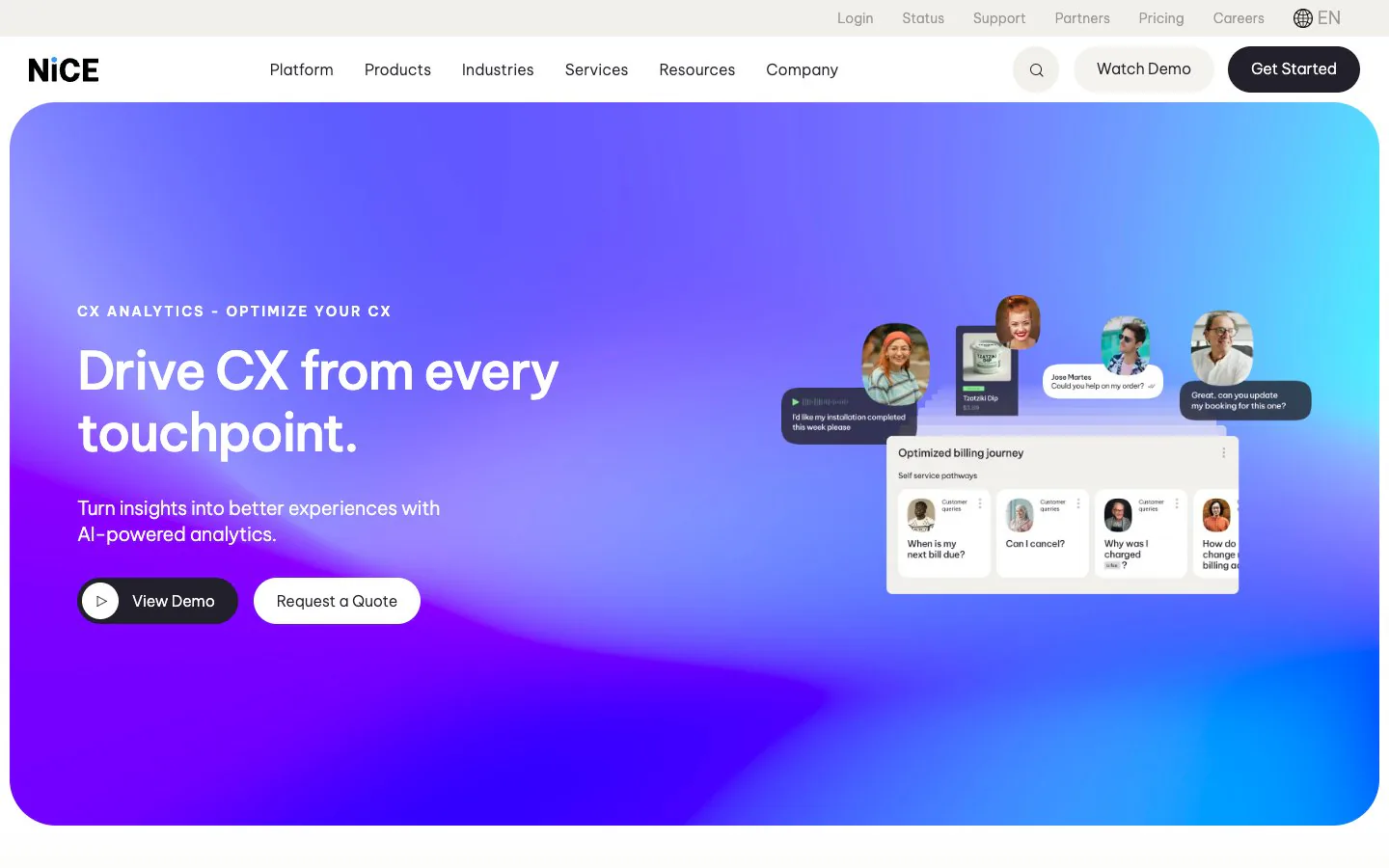
NICE CXone Contact Center as a Service (CCaaS) software bundles omnichannel routing, AI-powered analytics, workforce management, quality management, and performance reporting into the CXone cloud environment with shared data across the suite. NICE CXone serves enterprise contact centers running routing, recording, WFM, and quality management inside the CXone suite.
NICE CXone Contact Center as a Service (CCaaS) Software Types
| CCaaS Software Type | Description | NICE CXone Classification |
|---|---|---|
| Full-Suite CCaaS | Bundled voice, digital, AI, WFM, QA, and analytics | |
| Cloud-Native CCaaS | Born-in-cloud scalability and fast deployment | |
| UCaaS + CCaaS | Unified communications extended to contact center | — |
| API-First CCaaS | Programmable infrastructure for custom deployments | — |
| AI-Native CCaaS | Conversational AI and intelligent routing at the core | — |
NICE CXone Contact Center as a Service (CCaaS) Software Features
| CCaaS Software Feature | Feature Description | NICE CXone |
|---|---|---|
| Omnichannel Routing | Unified routing across voice, chat, email, SMS, and social | |
| Voice Infrastructure & Call Quality | Carrier-grade voice, global coverage, uptime SLAs | |
| AI & Conversational Intelligence | Virtual agents, real-time assist, sentiment analysis | |
| Workforce Management (WFM) | Forecasting, scheduling, adherence monitoring | |
| Quality Management | Recording, evaluation scorecards, calibration | |
| Reporting & Analytics | Real-time dashboards, historical reporting, custom KPIs | |
| IVR & Self-Service | Interactive voice response, conversational AI bots | |
| Integration & API Openness | Open APIs, pre-built integrations, data portability | |
| Security & Compliance | Encryption, PCI DSS, HIPAA, GDPR, data residency | |
| Scalability & Deployment | Multi-tenant architecture, global availability |
Standout Features and Capabilities of NICE CXone
- Enlighten AI: Applies packaged AI models across routing decisions, agent assist, and self-service inside the CXone suite
- Native WFM and QM: Ships forecasting, scheduling, adherence, recording, and quality management inside CXone, with suite modules reading shared interaction records
- CXone Expert: Surfaces knowledge articles on the agent desktop during live interactions from conversation context
Best Fit: Who Should Use NICE CXone
- Enterprise contact centers bundling routing, WFM, quality management, and analytics inside NICE CXone
- Multi-site contact centers standardizing routing, recording, and WFM on CXone cloud infrastructure
- Contact centers migrating NICE Engage recording and on-premises NICE deployments into CXone cloud
NICE CXone Considerations
- CXone implementations span module-by-module configuration, with enterprise deployments drawing on professional services
- Contact centers using dedicated WFM or QM software from other vendors should compare CXone bundled modules against that software before consolidating
- CXone pricing tiers bundle capabilities progressively, so contact centers needing routing and analytics alone should compare entry-level packages first
- Interaction-analytics data through CXone APIs requires Interaction Analytics licensed, so confirm API scope for interaction data reaching external software
NICE CXone Contact Center as a Service (CCaaS) Software Overview
NICE CXone CCaaS software fits enterprise contact centers bundling routing, WFM, quality management, and analytics inside the CXone suite.
Compare NICE Alternatives Across 13 Software Categories
2. Genesys Cloud CX CCaaS Software
Genesys Cloud CX Contact Center as a Service (CCaaS) software combines enterprise orchestration, omnichannel routing, AI-powered predictive engagement, workforce management, and journey analytics on cloud-native AWS microservices architecture. Machine learning matches customers with agents on predicted outcomes, with journey mapping tracking customer behavior across touchpoints before interactions reach an agent.
Genesys Cloud CX Contact Center as a Service (CCaaS) Software Types
| CCaaS Software Type | Description | Genesys Cloud CX Classification |
|---|---|---|
| Full-Suite CCaaS | Bundled voice, digital, AI, WFM, QA, and analytics | |
| Cloud-Native CCaaS | Born-in-cloud scalability and fast deployment | |
| UCaaS + CCaaS | Unified communications extended to contact center | — |
| API-First CCaaS | Programmable infrastructure for custom deployments | — |
| AI-Native CCaaS | Conversational AI and intelligent routing at the core | — |
Genesys Cloud CX Contact Center as a Service (CCaaS) Software Features
| CCaaS Software Feature | Feature Description | Genesys Cloud CX |
|---|---|---|
| Omnichannel Routing | Unified routing across voice, chat, email, SMS, and social | |
| Voice Infrastructure & Call Quality | Carrier-grade voice, global coverage, uptime SLAs | |
| AI & Conversational Intelligence | Virtual agents, real-time assist, sentiment analysis | |
| Workforce Management (WFM) | Forecasting, scheduling, adherence monitoring | |
| Quality Management | Recording, evaluation scorecards, calibration | |
| Reporting & Analytics | Real-time dashboards, historical reporting, custom KPIs | |
| IVR & Self-Service | Interactive voice response, conversational AI bots | |
| Integration & API Openness | Open APIs, pre-built integrations, data portability | |
| Security & Compliance | Encryption, PCI DSS, HIPAA, GDPR, data residency | |
| Scalability & Deployment | Multi-tenant architecture, global availability |
Standout Features and Capabilities of Genesys Cloud CX
- Predictive Routing: Matches customer interactions with agents on predicted outcomes, including resolution probability and customer satisfaction
- Journey Management and Predictive Engagement: Tracks customer behavior across web, mobile, and contact center touchpoints, prompting outreach before the customer reaches a queue
- AppFoundry Marketplace: Connects Genesys Cloud CX to 400+ pre-built integrations and partner applications
Best Fit: Who Should Use Genesys Cloud CX
- Enterprise contact centers routing customers on AI predictions of resolution likelihood and customer satisfaction
- CX teams mapping customer journeys across web, mobile, and contact center channels with proactive engagement before a queue forms
- Contact centers scaling on AWS through Genesys Cloud CX native hosting and microservices architecture
Genesys Cloud CX Considerations
- Predictive routing and journey management require interaction volume and historical data for model training, so smaller contact centers should confirm data thresholds with Genesys
- Genesys Cloud CX pricing varies by tier and consumption, so map expected usage across voice minutes, digital interactions, and AI features to model total cost
- Genesys Cloud CX is cloud-only, so contact centers with on-premises or data-residency requirements should evaluate migration and retention paths
- Genesys' AI scoring guidance directs customers to validate AI-generated evaluation results, so QA teams should plan calibration reviews when adopting auto-scoring
Genesys Cloud CX Contact Center as a Service (CCaaS) Software Overview
Genesys Cloud CX CCaaS software covers predictive routing, journey management, and composable microservices architecture on AWS for enterprise contact centers.
3. Five9 CCaaS Software
Five9 Contact Center as a Service (CCaaS) software delivers cloud-native routing with intelligent virtual agents and agent assist for mid-market and enterprise contact centers. Five9 Genius AI brings natural language processing, sentiment detection, and workflow automation into routing and self-service.
Five9 Contact Center as a Service (CCaaS) Software Types
| CCaaS Software Type | Description | Five9 Classification |
|---|---|---|
| Full-Suite CCaaS | Bundled voice, digital, AI, WFM, QA, and analytics | |
| Cloud-Native CCaaS | Born-in-cloud scalability and fast deployment | |
| UCaaS + CCaaS | Unified communications extended to contact center | — |
| API-First CCaaS | Programmable infrastructure for custom deployments | — |
| AI-Native CCaaS | Conversational AI and intelligent routing at the core | — |
Five9 Contact Center as a Service (CCaaS) Software Features
| CCaaS Software Feature | Feature Description | Five9 |
|---|---|---|
| Omnichannel Routing | Unified routing across voice, chat, email, SMS, and social | |
| Voice Infrastructure & Call Quality | Carrier-grade voice, global coverage, uptime SLAs | |
| AI & Conversational Intelligence | Virtual agents, real-time assist, sentiment analysis | |
| Workforce Management (WFM) | Forecasting, scheduling, adherence monitoring | |
| Quality Management | Recording, evaluation scorecards, calibration | |
| Reporting & Analytics | Real-time dashboards, historical reporting, custom KPIs | |
| IVR & Self-Service | Interactive voice response, conversational AI bots | |
| Integration & API Openness | Open APIs, pre-built integrations, data portability | |
| Security & Compliance | Encryption, PCI DSS, HIPAA, GDPR, data residency | |
| Scalability & Deployment | Multi-tenant architecture, global availability |
Standout Features and Capabilities of Five9
- Genius AI: Bundles intelligent virtual agents, agent assist, AI summarization, and workflow automation inside Five9 routing and self-service
- Agent Assist: Surfaces knowledge articles, response suggestions, and compliance reminders on the agent desktop during live conversations
- Outbound and Blended Voice: Runs predictive, progressive, and preview dialing with TCPA compliance controls for outbound and blended contact centers
Best Fit: Who Should Use Five9
- Mid-market and enterprise contact centers running voice-heavy contact volumes on cloud-native routing
- Contact centers moving from on-premises ACDs to cloud routing
- Contact centers keeping routing, WFM, quality management, and AI inside Five9
Five9 Considerations
- Contact centers requiring WFM or QM depth should compare Five9 native modules against dedicated WFM and QM software
- Genius AI capabilities continue expanding, so confirm which AI features are generally available and which sit in early access, including Agentic Quality Management scope for human-agent evaluation
- Confirm which Five9 WEM capabilities are native Five9 products and which arrive through OEM partners
- Confirm Five9 can send schedules, forecasts, adherence results, and staffing requirements to your analytics, payroll, QA, and performance management software in the required format and cadence
Five9 Contact Center as a Service (CCaaS) Software Overview
Five9 CCaaS software fits mid-market and enterprise contact centers running voice-heavy routing, outbound dialing, and packaged AI on cloud-native architecture.
Compare Five9 Alternatives Across 13 Software Categories
4. Zoom CCaaS Software
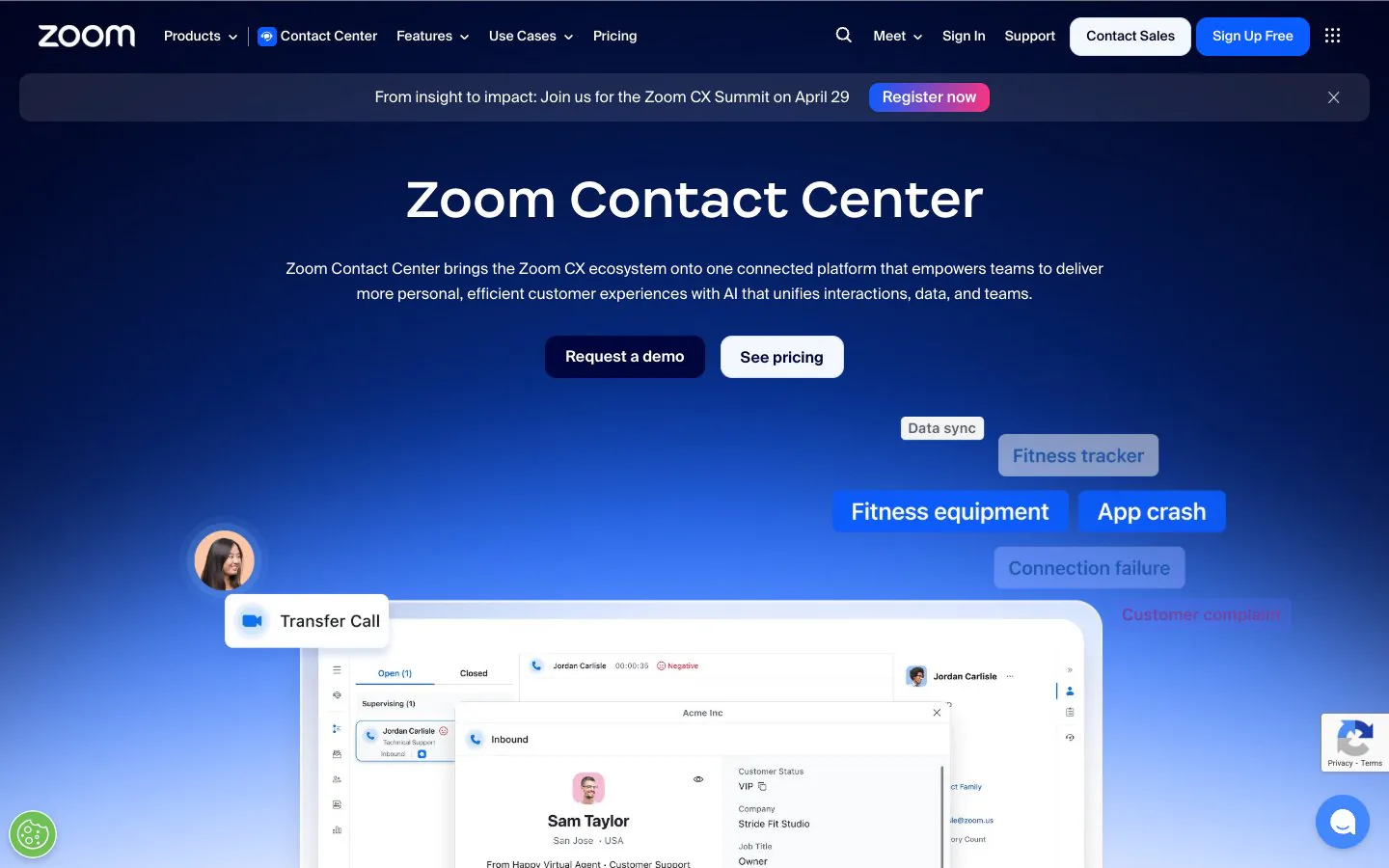
Zoom Contact Center as a Service (CCaaS) software extends the Zoom ecosystem with omnichannel routing, AI Companion-powered virtual agents, and video-native customer engagement. Zoom serves teams layering contact center capabilities onto established Zoom deployments.
Zoom Contact Center as a Service (CCaaS) Software Types
| CCaaS Software Type | Description | Zoom Classification |
|---|---|---|
| Full-Suite CCaaS | Bundled voice, digital, AI, WFM, QA, and analytics | — |
| Cloud-Native CCaaS | Born-in-cloud scalability and fast deployment | |
| UCaaS + CCaaS | Unified communications extended to contact center | |
| API-First CCaaS | Programmable infrastructure for custom deployments | — |
| AI-Native CCaaS | Conversational AI and intelligent routing at the core | — |
Zoom Contact Center as a Service (CCaaS) Software Features
| CCaaS Software Feature | Feature Description | Zoom |
|---|---|---|
| Omnichannel Routing | Unified routing across voice, chat, email, SMS, and social | |
| Voice Infrastructure & Call Quality | Carrier-grade voice, global coverage, uptime SLAs | |
| AI & Conversational Intelligence | Virtual agents, real-time assist, sentiment analysis | |
| Workforce Management (WFM) | Forecasting, scheduling, adherence monitoring | |
| Quality Management | Recording, evaluation scorecards, calibration | |
| Reporting & Analytics | Real-time dashboards, historical reporting, custom KPIs | |
| IVR & Self-Service | Interactive voice response, conversational AI bots | |
| Integration & API Openness | Open APIs, pre-built integrations, data portability | |
| Security & Compliance | Encryption, PCI DSS, HIPAA, GDPR, data residency | |
| Scalability & Deployment | Multi-tenant architecture, global availability |
Standout Features and Capabilities of Zoom
- Video-Native Engagement: Embeds video calling as a contact center channel for telehealth, financial services, technical support, and premium service conversations
- AI Companion: Runs virtual agents, real-time agent assistance, interaction summaries, and sentiment analysis on the AI engine shared across Zoom Meetings, Phone, and Contact Center
- Zoom Ecosystem Integration: Connects contact center routing to Zoom Meetings, Zoom Phone, and Zoom Team Chat, with agents escalating customer interactions to video consultations or expert conferences
Best Fit: Who Should Use Zoom
- Teams extending Zoom Meetings and Zoom Phone deployments into customer-facing contact center routing
- Contact centers serving customers over video, including telehealth, financial advice, and technical support conversations
- Distributed and remote teams standardizing customer conversations on Zoom clients agents already know
Zoom Considerations
- Zoom is a newer CCaaS entrant, so enterprise contact centers should evaluate Zoom reference deployments at their scale
- Zoom Quality Management is unavailable for highly regulated industries with specific compliance requirements, per Zoom's QM documentation
- QM and WFM ride Zoom's WEM packaging above base Contact Center licensing, so confirm package scope during evaluation
- Self-Healing Intraday shipped in spring 2026, so workforce teams with volatile intraday demand should confirm maturity at their volumes
Zoom Contact Center as a Service (CCaaS) Software Overview
Zoom CCaaS software fits contact centers running voice, video, and digital conversations alongside Zoom Meetings and Zoom Phone.
5. Talkdesk CCaaS Software
Talkdesk Contact Center as a Service (CCaaS) software delivers generative AI virtual agents, industry Experience Clouds, and omnichannel routing with quality management inside Talkdesk WEM. Talkdesk Autopilot handles complex inquiries through free-form conversational dialogue for contact centers from mid-market through enterprise scale.
Talkdesk Contact Center as a Service (CCaaS) Software Types
| CCaaS Software Type | Description | Talkdesk Classification |
|---|---|---|
| Full-Suite CCaaS | Bundled voice, digital, AI, WFM, QA, and analytics | |
| Cloud-Native CCaaS | Born-in-cloud scalability and fast deployment | |
| UCaaS + CCaaS | Unified communications extended to contact center | — |
| API-First CCaaS | Programmable infrastructure for custom deployments | — |
| AI-Native CCaaS | Conversational AI and intelligent routing at the core | — |
Talkdesk Contact Center as a Service (CCaaS) Software Features
| CCaaS Software Feature | Feature Description | Talkdesk |
|---|---|---|
| Omnichannel Routing | Unified routing across voice, chat, email, SMS, and social | |
| Voice Infrastructure & Call Quality | Carrier-grade voice, global coverage, uptime SLAs | |
| AI & Conversational Intelligence | Virtual agents, real-time assist, sentiment analysis | |
| Workforce Management (WFM) | Forecasting, scheduling, adherence monitoring | |
| Quality Management | Recording, evaluation scorecards, calibration | |
| Reporting & Analytics | Real-time dashboards, historical reporting, custom KPIs | |
| IVR & Self-Service | Interactive voice response, conversational AI bots | |
| Integration & API Openness | Open APIs, pre-built integrations, data portability | |
| Security & Compliance | Encryption, PCI DSS, HIPAA, GDPR, data residency | |
| Scalability & Deployment | Multi-tenant architecture, global availability |
Standout Features and Capabilities of Talkdesk
- Talkdesk Autopilot: Runs generative AI virtual agents through multi-turn, free-form customer conversations
- Industry Experience Clouds: Package pre-built integrations and workflows for healthcare (Epic EHR), financial services, retail, and government contact centers
- Talkdesk Copilot: Surfaces answers, knowledge articles, and response suggestions on the agent desktop during live conversations
Best Fit: Who Should Use Talkdesk
- Early-adopter contact centers running new Talkdesk generative AI, virtual agent, and agent assist capabilities
- Healthcare, financial services, and retail contact centers deploying Talkdesk Industry Experience Clouds with pre-built EHR, core banking, and commerce integrations
- Mid-market contact centers scaling into enterprise volumes on Talkdesk
Talkdesk Considerations
- Talkdesk ships features frequently, so confirm which capabilities are production-ready and which remain preview, including what-if forecasting and AI scenario creation
- Large enterprise deployments should validate Talkdesk reference customers at their scale
- Schedule and adherence APIs plus WFM reports require Business Intelligence Explore licensing, so confirm API access and report refresh timing
- Talkdesk forecasting reads Talkdesk queue history, so contact centers planning multi-CCaaS deployments should confirm external data handling
Talkdesk Contact Center as a Service (CCaaS) Software Overview
Talkdesk CCaaS software fits contact centers adopting generative AI virtual agents, Copilot assistance, and Experience Cloud workflows early.
6. Amazon Connect CCaaS Software
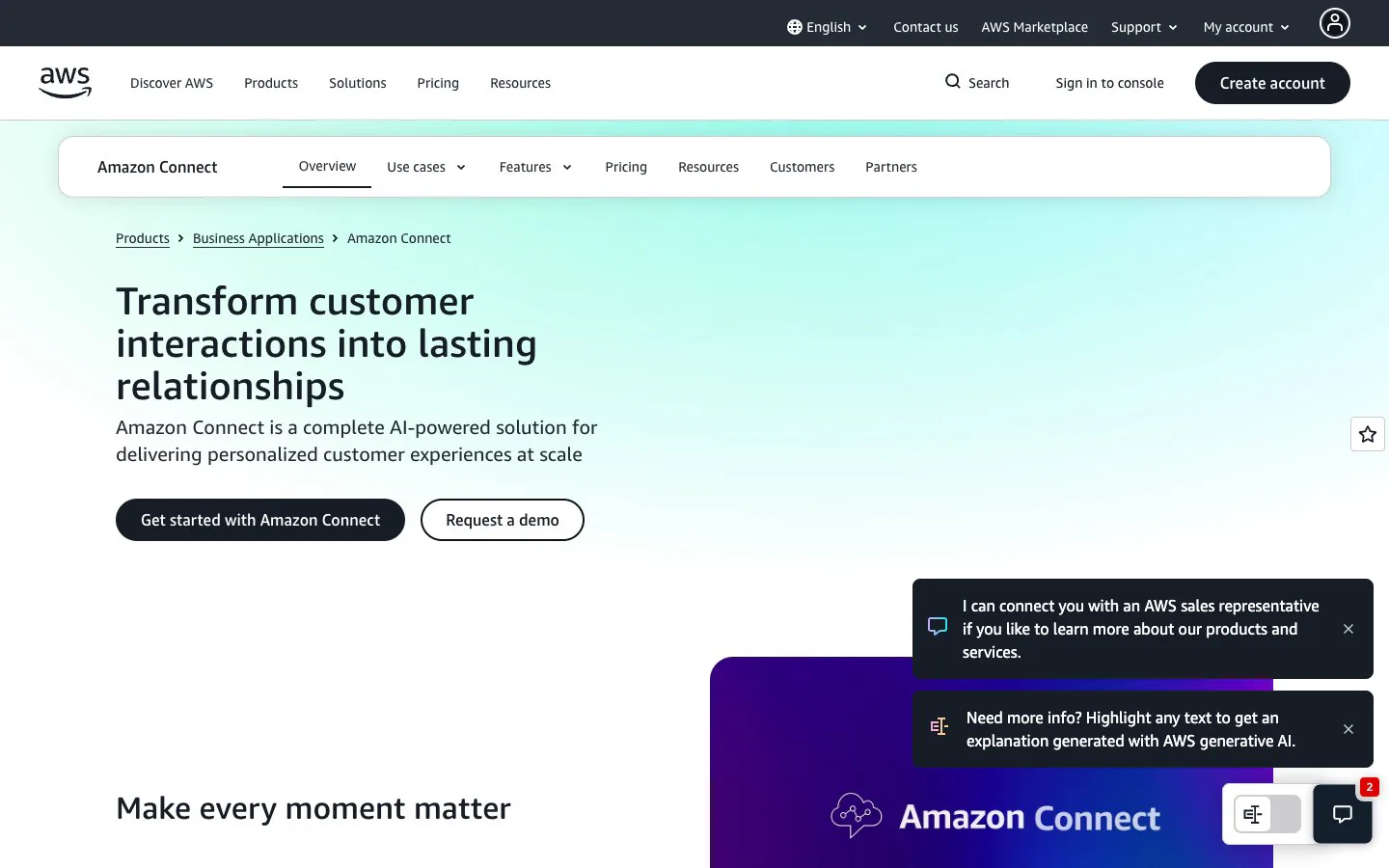
Amazon Connect Contact Center as a Service (CCaaS) software delivers voice and digital routing, IVR self-service, forecasting and scheduling, Contact Lens evaluations, and analytics as pay-per-use AWS building blocks. Engineering-led teams assemble custom contact center deployments from Connect and AWS services, including Lambda, Lex, and Bedrock.
Amazon Connect Contact Center as a Service (CCaaS) Software Types
| CCaaS Software Type | Description | Amazon Connect Classification |
|---|---|---|
| Full-Suite CCaaS | Bundled voice, digital, AI, WFM, QA, and analytics | — |
| Cloud-Native CCaaS | Born-in-cloud scalability and fast deployment | |
| UCaaS + CCaaS | Unified communications extended to contact center | — |
| API-First CCaaS | Programmable infrastructure for custom deployments | |
| AI-Native CCaaS | Conversational AI and intelligent routing at the core |
Amazon Connect Contact Center as a Service (CCaaS) Software Features
| CCaaS Software Feature | Feature Description | Amazon Connect |
|---|---|---|
| Omnichannel Routing | Unified routing across voice, chat, email, SMS, and social | |
| Voice Infrastructure & Call Quality | Carrier-grade voice, global coverage, uptime SLAs | |
| AI & Conversational Intelligence | Virtual agents, real-time assist, sentiment analysis | |
| Workforce Management (WFM) | Forecasting, scheduling, adherence monitoring | |
| Quality Management | Recording, evaluation scorecards, calibration | |
| Reporting & Analytics | Real-time dashboards, historical reporting, custom KPIs | |
| IVR & Self-Service | Interactive voice response, conversational AI bots | |
| Integration & API Openness | Open APIs, pre-built integrations, data portability | |
| Security & Compliance | Encryption, PCI DSS, HIPAA, GDPR, data residency | |
| Scalability & Deployment | Multi-tenant architecture, global availability |
Standout Features and Capabilities of Amazon Connect
- Pay-Per-Use Pricing: Charges voice by the minute and digital channels by the message, with cost scaling on actual interaction volumes
- Native AWS Service Integration: Connects Amazon Connect flows to Lambda, Lex, Polly, Bedrock, S3, and DynamoDB for custom workflows, AI models, and data pipelines
- Native Workforce Management: Ships forecasting, capacity planning, scheduling, and adherence inside Amazon Connect, with WFM data available through the analytics data lake
Best Fit: Who Should Use Amazon Connect
- AWS-based engineering teams assembling contact center flows from Connect building blocks and AWS services
- Contact centers with seasonal or variable volumes paying per-minute consumption pricing
- Teams running forecasting, scheduling, adherence, and Contact Lens evaluations native inside Amazon Connect
Amazon Connect Considerations
- Amazon Connect building-block architecture requires developer resources to configure workflows, integrate AWS services, and maintain the deployment
- Forecasting and scheduling cost $27 per forecasted or scheduled agent monthly after the 90-day trial, with Contact Lens priced per analyzed interaction
- Intraday forecasts require 5,000 contacts per queue-channel weekly, leaving lower-volume queues without intraday reforecasting
- Teams outside AWS should weigh broader AWS adoption, with Connect capabilities built for deployment alongside AWS services
Amazon Connect Contact Center as a Service (CCaaS) Software Overview
Amazon Connect CCaaS software covers routing, self-service, WFM, and Contact Lens evaluations as consumption-priced building blocks for AWS engineering teams.
7. RingCX CCaaS Software
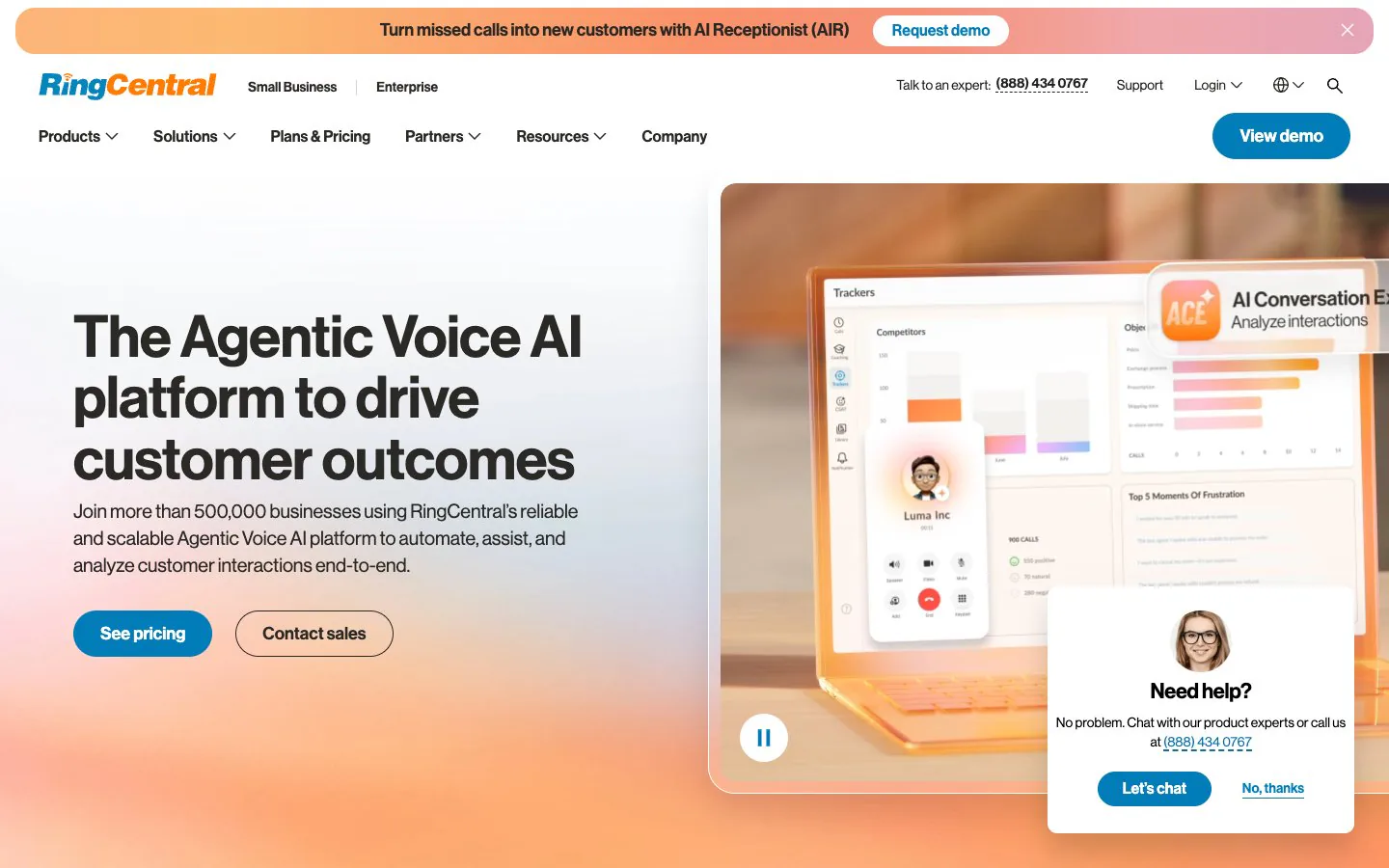
RingCX Contact Center as a Service (CCaaS) software extends RingEX unified communications into contact center routing, sharing directories, presence, and administration across internal collaboration and customer-facing conversations. RingWEM packages AI WFM, quality management, and screen recording alongside RingCX for teams running internal and customer-facing communications on RingCentral.
RingCX Contact Center as a Service (CCaaS) Software Types
| CCaaS Software Type | Description | RingCX Classification |
|---|---|---|
| Full-Suite CCaaS | Bundled voice, digital, AI, WFM, QA, and analytics | — |
| Cloud-Native CCaaS | Born-in-cloud scalability and fast deployment | |
| UCaaS + CCaaS | Unified communications extended to contact center | |
| API-First CCaaS | Programmable infrastructure for custom deployments | — |
| AI-Native CCaaS | Conversational AI and intelligent routing at the core |
RingCX Contact Center as a Service (CCaaS) Software Features
| CCaaS Software Feature | Feature Description | RingCX |
|---|---|---|
| Omnichannel Routing | Unified routing across voice, chat, email, SMS, and social | |
| Voice Infrastructure & Call Quality | Carrier-grade voice, global coverage, uptime SLAs | |
| AI & Conversational Intelligence | Virtual agents, real-time assist, sentiment analysis | |
| Workforce Management (WFM) | Forecasting, scheduling, adherence monitoring | |
| Quality Management | Recording, evaluation scorecards, calibration | |
| Reporting & Analytics | Real-time dashboards, historical reporting, custom KPIs | |
| IVR & Self-Service | Interactive voice response, conversational AI bots | |
| Integration & API Openness | Open APIs, pre-built integrations, data portability | |
| Security & Compliance | Encryption, PCI DSS, HIPAA, GDPR, data residency | |
| Scalability & Deployment | Multi-tenant architecture, global availability |
Standout Features and Capabilities of RingCX
- UCaaS + CCaaS Convergence: Merges internal communications and customer-facing routing on RingCentral, sharing user directories, presence status, and administration
- RingSense AI Quality Management: Auto-scores calls against contextual AI scorecards with supervisor review and override
- Expert Access: Brings back-office specialists and managers into customer conversations through the shared UCaaS directory on their standard RingCentral licenses
Best Fit: Who Should Use RingCX
- Teams adding RingCX customer routing alongside RingEX telephony under RingCentral administration
- Contact centers transferring customers to back-office experts through a shared UCaaS directory
- Mid-market contact centers standardizing agent and internal communications on RingCentral
RingCX Considerations
- RingCentral value centers on UCaaS + CCaaS convergence, so teams with established standalone communications should compare contact-center depth against dedicated CCaaS vendors
- Confirm whether AI Quality Management is included in your RingCX package or requires RingWEM or RingCX Elite
- Confirm API and export access for interaction, quality, and workforce data before committing to external analytics or performance management
- RingSense calibration runs through AI-assisted scorecard tuning and supervisor overrides, so QA teams running formal multi-evaluator calibration should confirm depth
RingCX Contact Center as a Service (CCaaS) Software Overview
RingCX CCaaS software fits contact centers converging internal and customer-facing communications under RingCentral administration.
8. 8x8 CCaaS Software
8x8 Contact Center as a Service (CCaaS) software combines UCaaS and CCaaS under the XCaaS model, bundling voice, video, team messaging, and omnichannel contact center routing into shared licensing tiers. 8x8 serves mid-market contact centers running unified communications and customer-facing routing on global cloud infrastructure spanning 35+ data centers.
8x8 Contact Center as a Service (CCaaS) Software Types
| CCaaS Software Type | Description | 8x8 Classification |
|---|---|---|
| Full-Suite CCaaS | Bundled voice, digital, AI, WFM, QA, and analytics | — |
| Cloud-Native CCaaS | Born-in-cloud scalability and fast deployment | |
| UCaaS + CCaaS | Unified communications extended to contact center | |
| API-First CCaaS | Programmable infrastructure for custom deployments | — |
| AI-Native CCaaS | Conversational AI and intelligent routing at the core | — |
8x8 Contact Center as a Service (CCaaS) Software Features
| CCaaS Software Feature | Feature Description | 8x8 |
|---|---|---|
| Omnichannel Routing | Unified routing across voice, chat, email, SMS, and social | |
| Voice Infrastructure & Call Quality | Carrier-grade voice, global coverage, uptime SLAs | |
| AI & Conversational Intelligence | Virtual agents, real-time assist, sentiment analysis | |
| Workforce Management (WFM) | Forecasting, scheduling, adherence monitoring | |
| Quality Management | Recording, evaluation scorecards, calibration | |
| Reporting & Analytics | Real-time dashboards, historical reporting, custom KPIs | |
| IVR & Self-Service | Interactive voice response, conversational AI bots | |
| Integration & API Openness | Open APIs, pre-built integrations, data portability | |
| Security & Compliance | Encryption, PCI DSS, HIPAA, GDPR, data residency | |
| Scalability & Deployment | Multi-tenant architecture, global availability |
Standout Features and Capabilities of 8x8
- XCaaS Licensing: Bundles UCaaS and CCaaS into shared tiers covering telephony, video, messaging, and contact center routing on an 8x8 contract
- Global Voice Infrastructure: Spans 35+ data centers with carrier-grade voice and geographic redundancy for international contact centers
- Intelligent Customer Assistant: Runs conversational AI virtual agents on routine inquiries across voice and digital channels before live-agent routing
Best Fit: Who Should Use 8x8
- Mid-market contact centers running UCaaS and CCaaS on 8x8
- Contact centers serving multiple countries on 8x8 global voice with regional data residency and international compliance certifications
- Contact centers pairing native routing with 8x8 built-in WFM for forecasting, scheduling, and adherence
8x8 Considerations
- Enterprise deployments with complex routing should evaluate 8x8 feature depth and reference customers at their scale
- XCaaS licensing rewards running UCaaS and CCaaS together, so standalone-CCaaS buyers should compare dedicated CCaaS vendors
- 8x8 native WFM ships forecasting, scheduling, and adherence at deliberately light depth, so confirm whether your interval and multi-skill requirements need a WFM partner integration
- Confirm auto-scoring scope and calibration support in 8x8 Quality Management for formal QA programs
8x8 Contact Center as a Service (CCaaS) Software Overview
8x8 CCaaS software covers UCaaS and CCaaS on shared XCaaS licensing for mid-market contact centers across global regions.
9. Dialpad CCaaS Software
Dialpad Contact Center as a Service (CCaaS) software runs customer-facing routing and real-time transcription on Dialpad's AI-native architecture and global voice network. Dialpad serves small to mid-size contact centers adding customer routing and Dialpad WFM to established Dialpad Connect deployments.
Dialpad Contact Center as a Service (CCaaS) Software Types
| CCaaS Software Type | Description | Dialpad Classification |
|---|---|---|
| Full-Suite CCaaS | Bundled voice, digital, AI, WFM, QA, and analytics | — |
| Cloud-Native CCaaS | Born-in-cloud scalability and fast deployment | |
| UCaaS + CCaaS | Unified communications extended to contact center | |
| API-First CCaaS | Programmable infrastructure for custom deployments | — |
| AI-Native CCaaS | Conversational AI and intelligent routing at the core |
Dialpad Contact Center as a Service (CCaaS) Software Features
| CCaaS Software Feature | Feature Description | Dialpad |
|---|---|---|
| Omnichannel Routing | Unified routing across voice, chat, email, SMS, and social | |
| Voice Infrastructure & Call Quality | Carrier-grade voice, global coverage, uptime SLAs | |
| AI & Conversational Intelligence | Virtual agents, real-time assist, sentiment analysis | |
| Workforce Management (WFM) | Forecasting, scheduling, adherence monitoring | |
| Quality Management | Recording, evaluation scorecards, calibration | |
| Reporting & Analytics | Real-time dashboards, historical reporting, custom KPIs | |
| IVR & Self-Service | Interactive voice response, conversational AI bots | |
| Integration & API Openness | Open APIs, pre-built integrations, data portability | |
| Security & Compliance | Encryption, PCI DSS, HIPAA, GDPR, data residency | |
| Scalability & Deployment | Multi-tenant architecture, global availability |
Standout Features and Capabilities of Dialpad
- Dialpad Ai Engine: Transcribes conversations in real time on Dialpad's in-house speech recognition, with live summaries on the agent desktop
- Dialpad WFM: Ships forecasting, scheduling, and adherence tracking from the Surfboard acquisition for small to mid-size teams
- Global Voice Network: Carries voice traffic on Dialpad's in-house telephony backbone across global regions
Best Fit: Who Should Use Dialpad
- Small to mid-size contact centers pairing Dialpad Connect telephony with customer-facing contact center routing
- Contact centers adding Dialpad WFM forecasting, scheduling, and adherence from the Surfboard acquisition
- Contact centers running voice and digital channels on Dialpad's global voice network
Dialpad Considerations
- Enterprise contact centers with complex omnichannel routing should compare Dialpad routing depth against the dedicated CCaaS suites
- Dialpad WFM is scoped for small to mid-size teams, with enterprise WFM arriving through a partner resell path
- QM governance, including calibration and evaluation-program management, remains lighter than dedicated quality management software, so formal QA programs should confirm depth
- Confirm which AI and contact center capabilities ride which Dialpad license tier during evaluation
Dialpad Contact Center as a Service (CCaaS) Software Overview
Dialpad CCaaS software fits small to mid-size contact centers running telephony, customer routing, and Dialpad WFM on an AI-native architecture.
10. Vonage CCaaS Software
Vonage Contact Center as a Service (CCaaS) software combines turnkey omnichannel routing with programmable CPaaS APIs for voice, messaging, and video, backed by Salesforce-native integration and a global telecommunications network. Vonage serves Salesforce-centric contact centers and developer teams running turnkey routing alongside API-built engagement flows.
Vonage Contact Center as a Service (CCaaS) Software Types
| CCaaS Software Type | Description | Vonage Classification |
|---|---|---|
| Full-Suite CCaaS | Bundled voice, digital, AI, WFM, QA, and analytics | — |
| Cloud-Native CCaaS | Born-in-cloud scalability and fast deployment | — |
| UCaaS + CCaaS | Unified communications extended to contact center | — |
| API-First CCaaS | Programmable infrastructure for custom deployments | |
| AI-Native CCaaS | Conversational AI and intelligent routing at the core | — |
Vonage Contact Center as a Service (CCaaS) Software Features
| CCaaS Software Feature | Feature Description | Vonage |
|---|---|---|
| Omnichannel Routing | Unified routing across voice, chat, email, SMS, and social | |
| Voice Infrastructure & Call Quality | Carrier-grade voice, global coverage, uptime SLAs | |
| AI & Conversational Intelligence | Virtual agents, real-time assist, sentiment analysis | |
| Workforce Management (WFM) | Forecasting, scheduling, adherence monitoring | — |
| Quality Management | Recording, evaluation scorecards, calibration | |
| Reporting & Analytics | Real-time dashboards, historical reporting, custom KPIs | |
| IVR & Self-Service | Interactive voice response, conversational AI bots | |
| Integration & API Openness | Open APIs, pre-built integrations, data portability | |
| Security & Compliance | Encryption, PCI DSS, HIPAA, GDPR, data residency | |
| Scalability & Deployment | Multi-tenant architecture, global availability |
Standout Features and Capabilities of Vonage
- CCaaS + CPaaS Hybrid: Packages turnkey contact center routing with programmable communications APIs for custom channels and developer-built workflows
- Salesforce-Native Integration: Embeds Vonage inside the Salesforce interface, routing interactions through Salesforce data and logging activity to Salesforce records
- Vonage Communications APIs: Ship programmable voice, SMS, WhatsApp, video, and verification building blocks that developer teams assemble into custom engagement flows
Best Fit: Who Should Use Vonage
- Salesforce-centric contact centers running Vonage routing and agent desktops inside the Salesforce interface
- Developer teams pairing contact center routing with Vonage programmable APIs for custom communication flows
- Global contact centers using Vonage international voice coverage and regional compliance certifications
Vonage Considerations
- Vonage WFM requires a third-party product through marketplace integration, so workforce teams should plan vendor selection and data flows alongside the CCaaS decision
- Quality management runs through Conversation Analyzer transcription and tagging, so formal evaluation programs should confirm scorecard and calibration depth
- Vonage routing and agent desktops read and write Salesforce records, so contact centers on other CRM software should validate integration depth for their CRM
- Vonage AI capabilities continue expanding under Ericsson ownership, so confirm current virtual assistant and AI depth for your requirements
Vonage Contact Center as a Service (CCaaS) Software Overview
Vonage CCaaS software covers turnkey routing, Salesforce-embedded agent desktops, and programmable communications APIs for global contact centers with developer teams.
Connect Your CCaaS Data to Unified CX and Performance Management
CCaaS generates the interaction data your contact center runs on, including call recordings, transcripts, routing outcomes, queue metrics, and handle times. Measuring those interactions against service quality, customer outcomes, and business results requires CCaaS data to be unified with CRM, WFM, QA, survey, and business data. Provider-native QM and analytics are limited to data available inside their suite.
CCaaS providers deliver quality management, analytics, and WEM as suite modules or add-on packages, with integrations built to exchange interaction data rather than unify contact center and business data across providers, sites, and BPO partners. AmplifAI is a source-agnostic platform for CX and performance management that ingests and unifies interaction, quality, customer, workforce, and business data from any source, with unified data powering quality management, coaching, performance analytics, role-based next best actions, recognition, and outcome measurement above the CCaaS infrastructure.
AmplifAI ingests recordings, transcripts, routing outcomes, queue metrics, and agent-state data from 150+ data sources, including NICE CXone, Genesys Cloud CX, Five9, Zoom, Talkdesk, Amazon Connect, RingCX, 8x8, Dialpad, and Vonage. Speak to a CX leader at AmplifAI to see how AmplifAI turns your CCaaS interaction data into role-specific actions and measurable performance improvement.
How to Choose Contact Center as a Service (CCaaS) Software
When choosing Contact Center as a Service (CCaaS) software, map how customer interactions are routed today, where customer conversations and their records live, which roles need to act on interaction findings, and how CCaaS data is connecting with the quality, coaching, and performance management layer above it.
- Define the problem CCaaS needs to solve. Document where routing misses qualified agents, channels run disconnected, self-service fails to resolve, agents switch between disconnected desktops, or customer conversations run through shared inboxes and forwarded lines with no routing at all. Set measurable targets for service levels, first contact resolution, handle time, and self-service containment.
- Map CCaaS inputs and outputs. Identify where customer conversations originate across voice, chat, email, SMS, social, and messaging, then decide where recordings, transcripts, routing outcomes, and queue metrics must go after CCaaS produces them.
- Choose an architecture that fits your deployment. Use the Types of Contact Center as a Service (CCaaS) Software to compare full-suite, cloud-native, UCaaS + CCaaS, API-first, and AI-native CCaaS based on your existing communications software, engineering resources, and required data movement.
- Separate required capabilities from optional features. Use the Contact Center as a Service (CCaaS) Software Features and capability coverage scores to set requirements based on channel mix, interaction volumes, suite scope, and integration openness.
- Test vendors with your data. Use the Contact Center as a Service (CCaaS) Software Evaluation Criteria throughout discovery, demonstrations, data assessments, and proofs of concept. Give vendors representative call volumes and channel traffic, then compare routing behavior, voice quality, admin workflows, data exports, implementation effort, and cost.
- Plan for decisions after CCaaS. Confirm which roles receive interaction findings and how recordings, transcripts, and queue data will be measured against service quality, agent performance, and customer outcomes.
Read AmplifAI's guide to the best call center performance management software of 2026 to compare vendors that extend interaction data beyond routing, queues, and recordings into contact-center-wide performance management.
If you need support comparing Contact Center as a Service (CCaaS) software vendors, speak to a CX leader at AmplifAI.
Speak to a CX Leader at AmplifAI
Customer Service and Support Software Buyer's Guides
AmplifAI's CX specialists research and evaluate customer service and support software for CX leaders, contact center leadership, and customer service teams. AmplifAI's buyer's guides compare vendors on software types, category features, best-fit use cases, and considerations, with evaluation criteria for testing a shortlist against your contact center's requirements.
| Software Buyer's Guide | What It Covers | Top Vendors |
|---|---|---|
| Call Center Software | Complete taxonomy of call center software categories with top vendors for customer service and support | AmplifAI, NICE, Genesys, Verint, CallMiner |
| Contact Center as a Service (CCaaS) Software | Full review and comparison of the best Contact Center as a Service (CCaaS) software in 2026 | NICE CXone, Genesys Cloud CX, Five9, Zoom, Talkdesk |
| Call Center CRM Software | Full review and comparison of the best call center CRM software in 2026 | Salesforce Service Cloud, Microsoft Dynamics 365, HubSpot Service Hub, Zoho CRM, Oracle CX |
| Contact Center AI Software | Full review and comparison of the best contact center AI software in 2026 | AmplifAI, Dialpad, Five9, Genesys, NICE |
| AI Agent Management Software | Full review and comparison of the best AI agent management software for customer service in 2026 | AmplifAI, Cresta, NICE, Observe.AI, Kore.ai |
| Call Center Workforce Management Software | Full review and comparison of the best call center workforce management software in 2026 | NICE CXone, Verint, Genesys Cloud, Assembled, Five9 |
| Call Center Speech Analytics Software | Full review and comparison of the best call center speech analytics software in 2026 | AmplifAI, CallMiner, NICE, Observe.AI, Verint |
| Call Center Analytics Software | Full review and comparison of the best call center analytics software in 2026 | AmplifAI, NICE CXone, Verint, Genesys Cloud, CallMiner |
| Call Center QA Software | Full review and comparison of the best call center QA software in 2026 | AmplifAI, CallMiner, Dialpad, NICE, Observe.AI |
| Call Center Performance Management Software | Full review and comparison of the best call center performance management software in 2026 | AmplifAI, Calabrio One, Genesys, NICE, Verint |
| Call Center Coaching Software | Full review and comparison of the best call center coaching software in 2026 | AmplifAI, CallMiner, Dialpad, Genesys, Verint |
| Call Center Gamification Software | Full review and comparison of the best call center gamification software in 2026 | AmplifAI, Centrical, Cresta, Genesys, NICE |
| Customer Insights Software | Full review and comparison of the best customer insights software in 2026 | AmplifAI, CallMiner, Cresta, Observe.AI, Tethr |